
Do I have Enough to Retire? Why Cashflow Modelling Matters for Expat Retirement Planning

A retirement number tells you where you might end up. Cashflow modelling shows how you get there, income, expenditure, and assets mapped year by year, stress-tested against scenarios that actually happen: a market fall in year one, currency drift, a care event in later life, a property that might or might not make sense to keep. The difference between the two isn't precision; it is having a clear picture of your options before decisions become irreversible.
Table of Contents
- Key Takeaways
- Meet Mark and Claire
- The Questions Behind the Numbers
- Why the Fact Find Matters for Cashflow Modelling?
- What Can a Cashflow Model Can Show
- Why This Matters More for Expats?
- The Role of Advice
- What Would Your Model Show?
- FAQs
.jpg)
Key Takeaways
- For expats, retirement planning often involves more than one country, currency, pension, property, and tax system.
- A basic retirement calculator may give a number, but a cashflow model shows how income, expenditure, pensions, investments, liabilities, and future spending interact year by year.
- In this case study, Mark and Claire are British expats in Malaysia who want to know whether Mark can retire at 60 while maintaining their current lifestyle.
- Their plan also needs to assess whether keeping or selling their UK rental property makes better sense for their long-term financial future.
- Cashflow modelling helps test different scenarios, including early retirement, rental income, inflation, currency movement, investment performance, and withdrawal strategy.
- For internationally mobile families, it provides clearer insight into cross-border financial decisions before they become harder to reverse.
Cashflow modelling helps expats move from guessing whether their retirement plan will work to understanding what needs to happen to make it work.
Meet Mark & Claire
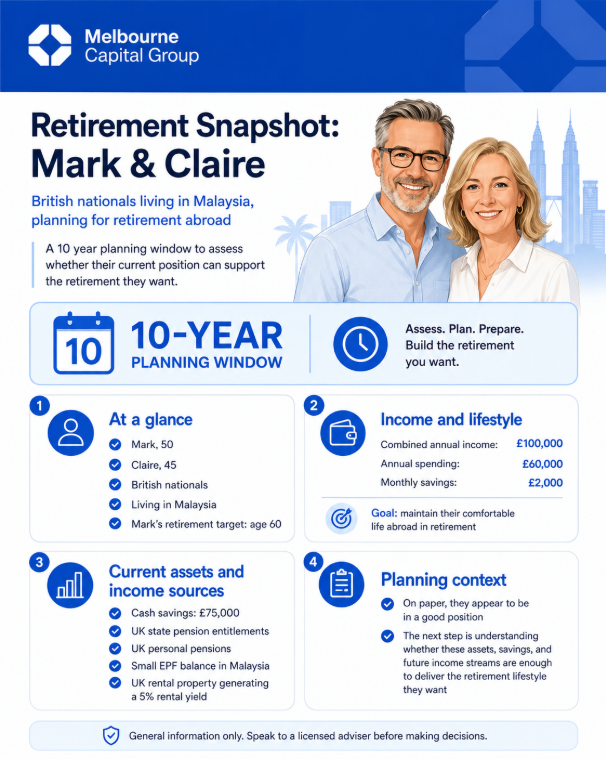
Mark is 50, and Claire is 45. They are British nationals living in Malaysia and are beginning to think seriously about retirement. They have built a comfortable life abroad and want to maintain it when they stop working. Mark's objective is to retire at 60, which gives them a 10-year planning window to assess whether their current position can support the retirement they want.
On paper, they appear to be in a good position.
They each earn £50,000 each a year and spend around £60,000 annually between them. They are saving £2000 a month, have cash savings of £75,000, hold UK state and personal pension entitlements, have a small EPF balance in Malaysia, and own a rental property in the UK generating a 5% rental yield.
But like many expats, their financial position isn't straightforward.
Their pensions are linked to the UK. Their current lifestyle costs are based in Malaysia. Their rental income comes from overseas property. Their future income may be affected by currency movements, tax treatments, inflation and decisions around when and how to draw from different countries.
Individually, each part may seem manageable. Together, they create a financial planning picture that needs to be assessed properly.
Mark and Claire are a hypothetical case study created for illustrative purposes only. They do not represent actual clients of Melbourne Capital Group, and any resemblance to real individuals is coincidental. Figures used are for demonstration purposes and are not projections or recommendations.
The Questions Behind the Numbers
Mark and Claire came into the planning process with two main questions.
The first was whether Mark could realistically retire at 60 without running out of money later in life.
This is not just a question of whether they have enough saved today. Retirement planning needs to consider future spending, inflation, investment performance, pension start dates, withdrawal strategy, tax treatment, and the order in which different assets are used.
A plan that looks comfortable at 60 may not remain comfortable at 75 or 85 if the wrong assumptions are made.
The second question was whether they should keep or sell their UK rental property.
The property gives them rental income, which supports their financial future. But it also ties up capital, carries maintenance and management costs, exposes them to the UK property market, and adds currency risk because their spending is largely based in Malaysia.
Selling the property could release capital that may be invested through more suitable investment structures. Keeping it may provide ongoing income and long-term asset value.
Neither answer is automatically right. The right decision depends on how the property fits into the wider financial plan.
Why does the Fact-Find Matter for Cashflow Modelling?
Before any cashflow model can be built, the adviser needs to understand the full picture.
A fact-find is a detailed financial review covering income and expenditure, pensions, bank accounts, investments, property, liabilities, mortgage commitments if any, future spending needs, financial goals, family circumstances, and major life events that may affect the plan.
For Mark and Claire, this step helped highlight several important planning points.
They were holding a large cash surplus, which felt safe but could lose purchasing power over time. They had pensions and assets spread across different structures. Their UK property was producing income, but it was unclear whether it remained the best use of capital. Their retirement goal was clear, but the route to achieving it still needed to be tested.
This is where expert advice matters. A model is only useful if the information behind it is accurate, personalised, and interpreted properly.
What Can a Cashflow Model Actually Show You?
Once the information is gathered, the cashflow model can map the client’s financial future year by year.
For Mark and Claire, this means looking at their current income, expenditure, savings rate, pensions, rental income, cash reserves, investment portfolio, and future retirement spending.
From there, different scenarios can be tested.
One scenario may show what happens if they keep the UK property. Another may show what happens if they sell it and reinvest the proceeds. A further scenario may compare early retirement at 60 with working for a few more years. Other scenarios can test inflation, market falls, currency changes, higher healthcare costs, or increased expenditure later in life.
This is where cashflow modelling becomes more useful than a static spreadsheet.
Instead of asking, “Can we retire at 60?”, Mark and Claire can begin asking, “What needs to happen for retirement at 60 to work?”
Instead of asking, “Should we sell the property?”, they can ask, “Which option gives us more flexibility, income stability, and long-term financial freedom?”
The model does not remove uncertainty. It gives clients clearer insight into the financial decisions in front of them.
Are you ready for retirement? Click here
Why This Matters More for Expats
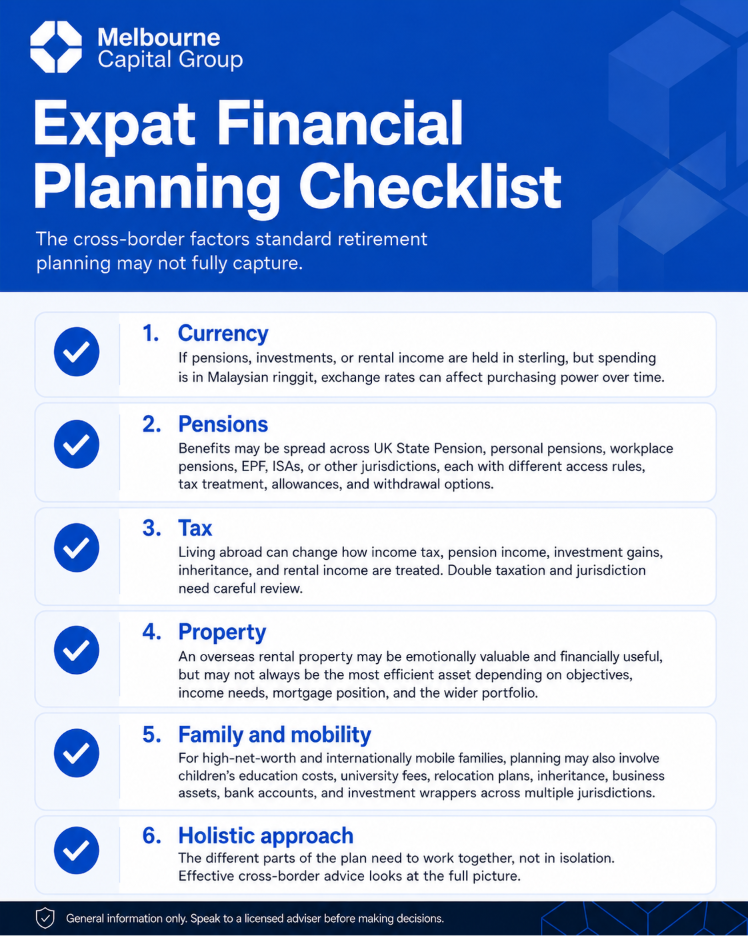
Expat financial planning often involves variables that standard retirement planning may not fully capture.
Currency is one of the most obvious. If pensions, investments, or rental income are held in sterling, but day-to-day expenditure is in Malaysian ringgit, exchange rates can affect purchasing power over time.
Pensions can also be fragmented. Expats may have UK state pension entitlements, personal pensions, workplace pensions, EPF, ISAs, or pension benefits in other jurisdictions. Each may have different access rules, tax treatment, allowances, and withdrawal options.
Tax is another key factor. Living abroad can change how income tax, pension income, investment gains, inheritance, and rental income are treated. Avoiding double taxation and understanding the relevant jurisdiction are important parts of cross-border advice.
Property can also add complexity. A rental property overseas may be emotionally valuable and financially useful, but it may not always be the most efficient asset to hold depending on the client’s objectives, income needs, mortgage position, and wider portfolio.
For high-net-worth and internationally mobile families, the picture may be even more layered. There may be children’s education costs, university fees, relocation plans, inheritance considerations, business assets, different bank accounts, and investment wrappers across multiple jurisdictions.
That is why a holistic approach matters. A wealth manager or financial planner needs to assess how the different parts of the plan work together, not in isolation.
What Role Does Financial Advice Play in Cashflow Modelling?
A cashflow model is not a prediction. It is a planning tool.
It helps clients visualise possible outcomes, test assumptions, and understand the trade-offs behind major financial decisions. But the model itself does not make the decision. The advice around it is what turns the information into a personalised plan.
For Mark and Claire, the objective is not simply to maximise investment returns. It is to understand whether their wealth can support the life they want, where the risks are, and what action may be needed while they still have time to make changes.
That may include reviewing their pension position, reassessing their property strategy, optimising their investment portfolio, considering tax-efficient structures, or adjusting their retirement timeline.
Past performance is not a guide to future returns, and every plan needs to be reviewed regularly. Life changes, markets move, tax rules evolve, and personal priorities shift. A strong financial plan should be proactive enough to adapt.
What Would Your Model Show?
Mark and Claire’s situation is only one example.
Your own cashflow model may look very different. You may be planning a relocation, managing a mortgage overseas, reviewing a Swiss pension or UK pension, preparing for children’s education, thinking about inheritance, or trying to work out whether early retirement is possible.
The details will differ, but the principle is the same.
A good financial plan should not be built around one number. It should show how your income, expenditure, investments, pensions, liabilities, tax position, and future spending may interact over time.
For expats and international families, that level of insight can be the difference between hoping the plan works and knowing what needs to happen to make it work.
At Melbourne Capital Group, cashflow modelling is used as part of a wider financial planning process to help clients understand where they stand today, what choices they have, and how to build a more informed path towards their financial future.
Get in touch by email at daniellees@melbournecapitalgroup.com to arrange a complimentary discovery call.
.jpg)
FAQs
1. What is cashflow modelling and how is it different from a retirement calculator?
A retirement calculator typically takes a savings figure, applies an assumed return, and produces a single end number. Cashflow modelling maps every income source, asset, liability, and planned expenditure year by year, then runs multiple scenarios simultaneously, different retirement ages, currency rates, care costs, and market sequences, so you can see a range of outcomes rather than one figure built on fixed assumptions.
Read more: Why Don’t Retirement Calculators Work for Expats?
2. Does where I retire affect how my UK pension is taxed?
Tax treatment of UK pension income depends on your country of tax residency and whether a Double Taxation Agreement exists between the UK and that country. For British expats in Malaysia, the UK-Malaysia DTA may allow for more favourable treatment of certain pension income than if the pension were assessed in the UK. The specifics depend on individual circumstances and are worth confirming with a qualified adviser before drawing.
Read more: UK pensions abroad
Melbourne Capital Group are not tax advisers. The above is general information only and does not constitute tax advice. Please speak with a qualified tax adviser regarding your specific position.
3. My UK pensions hasn't been reviewed in years, does that matter?
Older UK pension schemes often default into investment strategies that no longer reflect the owner's risk appetite, retirement timeline, or access needs. Unreviewed pensions can also be de-risked too early by the provider, leaving growth potential unrealised in the years leading up to retirement. For expats specifically, some older schemes may also lack the flexibility needed for cross-border drawdown. A pension review is generally worthwhile if circumstances have changed since the pension was last actively managed.
4. What happens to my EPF if I leave Malaysia before retirement?
EPF rules for non-Malaysians differ from those for Malaysian citizens. Expats who became EPF members after August 1998 can generally only make a full withdrawal upon reaching age 55, with no partial or early withdrawal options available in the interim. EPF balances also pass via a direct nomination registered with EPF rather than through a will, so ensuring nominations are current is an important step that sits alongside any wider estate or retirement plan.
5. Is cashflow modelling only relevant close to retirement?
A model built 10 or 15 years before retirement gives the most room to act on what it reveals whether that's adjusting a savings rate, reviewing a pension structure, topping up a state pension record, or reconsidering a property. Many of the decisions that have the greatest impact on retirement income work best when made well ahead of the transition, rather than in the final few years when fewer options remain.
.webp)
Explore our Insights
Our team of global experts share their perspective on markets and news from the company.
.jpg)

.jpg)
.jpg)