

I’ve seen all kinds of financial calculators and spreadsheets. Some are impressive, but most still miss important gaps, when it comes to financial planning for expats. Many retirement calculators are built around a single currency, a flat inflation rate, and one home country’s tax and pension system, which may work for someone who earns, spends, and retires in the same place. But expats often sit outside that scope, with income, spending, pensions, and assets spread across different countries and currencies. In that situation, factors such as currency fluctuation, cross-border tax treatment, frozen state pensions, and drawdown sequencing can significantly affect whether you actually reach your retirement goals.
At Melbourne Capital Group, we use Voyant, a specialist cashflow modelling software that maps these factors directly against your financial goals, year by year. It does not simply help you determine a realistic pathway to achieve the retirement income you're looking for; it shows the full picture through clear visuals and stress testing against real-life scenarios. As an expat myself, I used to have my own Excel sheet too. Now, I have my own financial model, and that makes a big difference.
To learn more about managing retirement planning, click here .
Table of Contents
- Key Takeaways
- Why don't regular retirement calculators handle multiple currencies for expats?
- Why does a single inflation rate fail to account for expats across different countries?
- How does cross-border tax affect an expat's pension?
- Does my state pension increase if I retire abroad?
- How does drawdown sequencing affect fragmented retirement pots?
- What does cashflow modelling do differently?
- FAQs
.jpg)
Key Takeaways
- Currency drift between where you earn and where you spend can move retirement numbers significantly over a long projection.
- A single flat inflation rate misses how much the cost of living and later-life costs vary by country.
- Cross-border tax treatment can change how the same pension is taxed, depending on residency and applicable tax treaties
- UK state pensions paid abroad are typically frozen at the rate first paid, with gaps in National Insurance contributions common among expats.
- Drawdown Sequencing across fragmented pots (QROPS, SIPPs, EPF, and similar) materially affects how long retirement savings last.
- Cashflow modelling maps all of this year by year and stress-tests it, rather than producing one static number.
1. Why don't regular retirement calculators handle multiple currencies for expats?
Most calculators I have come across assume one currency in and one currency out. That's rarely how expat finances actually work; many of the people I sit down with hold international accounts across several currencies and countries, draw from more than one income source, and spend in a currency that isn't the one they earned in.
Whether it's the South African Rand, Indonesian Rupiah, Turkish Lira, or even the US dollar lately, currency drift is a huge factor over long projection. Earning in one currency and spending in another, or planning to retire somewhere different again, can shift the number substantially. Currency exposure is also not one-directional: favourable moves can work in a retiree's favour just as unfavourable ones can erode a plan, which is part of why this needs modelling rather than a fixed assumption. Cashflow modelling software like Voyant builds the plan around the currency that actually matters for your retirement, rather than defaulting to a single home-country assumption.
Are you retirement-ready? Click here to learn more.
2. Why does a single inflation rate fail to account for expats across different countries?
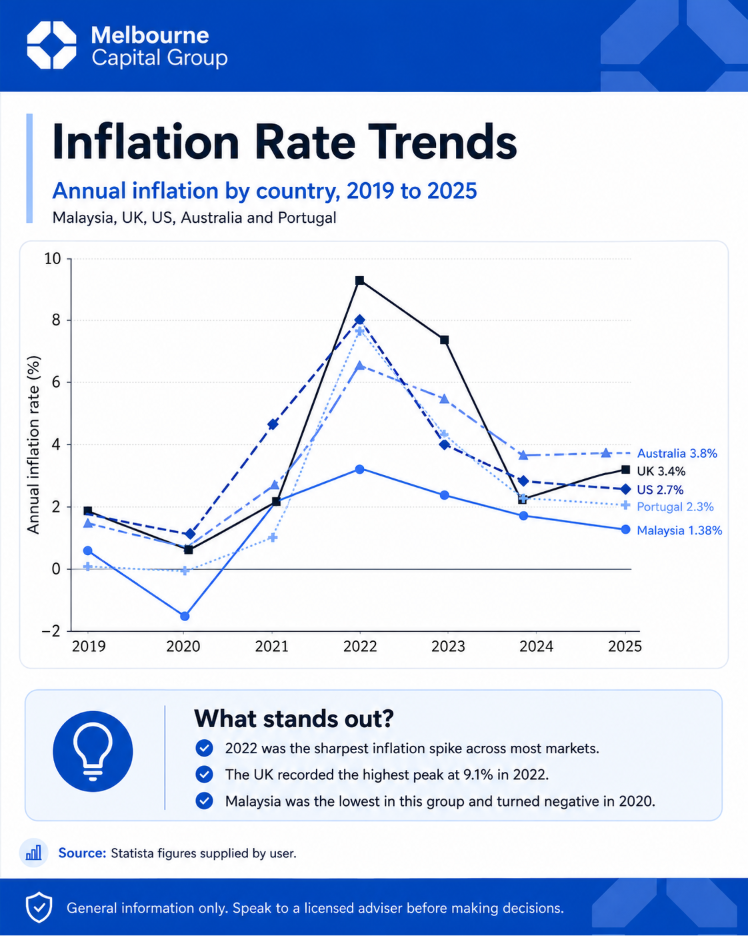
Most calculators apply a flat inflation rate, say 2% or 2.5%, and run it forever. In reality, inflation varies widely from one country to another. India and Indonesia, for example, tend to run higher than the developed world average, and the rate that matters changes the moment the country does.
The cost of living differs just as much, and so do later-life costs, especially. For example, care in the UK or Europe can run several times what it costs in parts of Southeast Asia, a meaningful factor when deciding where to be in your eighties, and whether your desired lifestyle is still affordable there. For context, the overall cost of living in Malaysia runs roughly 40% lower than in UK. Though the exact gap depends on lifestyle and location within each country. A flat-rate calculator cannot represent this as a year-by-year model can.
3. How does cross-border tax affect an expat's pension?
Most calculators assume a single tax regime, and some don't account for tax at all. Every country taxes differently, not just at a different headline rate, but often in how it treats the same type of income entirely.
Take a UK private pension for example. A British expat retiring in Malaysia will generally find that pension is taxed quite differently than if they'd stayed in the UK. A calculator usually has no way to reflect that difference. Under the UK-Malaysia Double Taxation Agreement, a Malaysian tax resident may be able to apply for NT ("No Tax") code, allowing the pension to be paid gross from the UK and assessed under Malaysian rules instead. Same pension, two different outcomes, and overall, a full retirement; that difference compounds.
If you need guidance on how to apply for the "No Tax" code, click here .
4. Does my state pension increase if I retire abroad?
Many calculators assume either full or no state support. The UK's inflation-linked state pension is a good example of where those assumptions break down, specifically for expats.
Two gaps come up often. First, years spent working abroad can mean missed National Insurance contributions, leaving the eventual state pensions smaller than assumed. Many expats have gaps in their records that they aren't aware of. Checking your forecast and topping up where eligible is generally only possible if you know to look for it.
Second, the freeze: as an expat, the UK state pension is typically frozen at the rate first paid, with no annual increase and no triple lock applied going forward. Someone retiring today could be drawing the same fixed figure decades from now while living costs around them continue to rise.
To learn more about what happens to your UK pensions after leaving the UK, click here .
5. How does drawdown sequencing affect fragmented retirement pots?
Retirement calculators typically return one number: a total pot, or a sustainable annual withdrawal figure. What they generally don't show is sequencing: which pot to draw from and when to get the most out of everything that's been built. That order can materially affect how long the money lasts.
This matters more for expats because the pots themselves behave differently. A QROPS doesn't follow the same rules as a SIPP, nor does it follow the same access rules, tax treatment, or timing as a local scheme like Malaysia's EPF. Most expats end up with retirement savings fragmented across several countries, and bringing those into a single retirement plan with a deliberate, efficient drawdown order is something a standalone calculator isn't built to do.
To learn more about EPF as an expat, click here.
6. What does cashflow modelling do differently?
A single number can't answer whether someone is genuinely on track to meet their retirement goals; that depends on currencies, pensions, timelines and where in the world the retirement will actually be spent. A default figure at a default age is closer to a guess dressed up as a plan than a real answer.
Cashflow modelling works differently. It maps your real financial life year by year and stress-tests it against the scenarios that matter most to internationally mobile families. The result is a plan built around what an individual retiree actually needs, reflecting how your future is likely to unfold, rather than relying on a single static calculation and hoping it holds true.
Ready to see your numbers properly mapped out?
That first conversation is exactly that, a conversation. No obligation, no pressure, just your numbers mapped out properly so you can see where you genuinely stand. Get in touch via email at daniellees@melbournecapitalgroup.com to arrange a complimentary discovery call.
FAQS
1. Can I adjust a normal retirement calculator for my situation as an expat?
Most calculators aren't built with fields for multiple currencies, country-specific inflation, or cross-border tax treaties, so manual adjustments tend to miss interactions between these factors rather than capture them. A cashflow modelling software is generally built to handle these variables from the start.
2. Will my UK state pension increase each year if I retire in Malaysia?
UK state pensions paid to expats outside specific countries with reciprocal agreements are typically frozen at the rate first paid, without the annual increases or triple lock applied to pensions paid within the UK. Confirming your specific position with HRMC or a qualified adviser is worthwhile, given how much it affects long-term planning.
3. What's the difference between a QROPS and a SIPP for an expat's retirement planning?
Both are UK-originated pension structures, but they differ in access rules, tax treatment, and where they sit once you've left the UK. Getting the sequencing right across these, and any local schemes like Malaysia's EPF, generally benefits from a coordinated cashflow plan rather than treating each pot in isolation.
This article is for general information only and does not constitute financial, tax, or legal advice.
.webp)
Explore our Insights
Our team of global experts share their perspective on markets and news from the company.
.jpg)

.jpg)
.jpg)