
Australia Has Changed the Tax Rules for Investors. Here's What You Need to Know
.jpg)
From 1 July 2027, two long-standing features of Australia's investment tax system change.
For affected capital gains, the 50% CGT discount is generally replaced by inflation-based cost-base indexation.
For affected established residential property, the ability to offset investment losses against salary and other income is restricted.
Both changes are now law.
Why now? Treasury has framed the changes as part of a broader budget repair and housing affordability agenda: shifting capital gains tax toward taxing real (inflation-adjusted) gains rather than nominal ones, while narrowing negative gearing on established property to reduce investor competition with owner-occupiers in the resale market. Whatever the merits of that policy goal, the practical effect for investors is what matters here: how the numbers actually change, and what to do about it.
And while much of the attention has been on property, the CGT changes can also matter for shares, ETFs, managed funds and business interests.
So what could the difference look like?
Capital gains: what could this mean for an investor with $150,000 of other taxable income?
Australian resident individuals have generally been able to receive a 50% CGT discount on eligible assets held for at least 12 months.
From 1 July 2027, the 50% CGT discount will generally be replaced for affected gains with cost-base indexation. Rather than reducing an eligible gain by 50%, the cost base is adjusted for inflation so that tax applies to the real gain.
A minimum tax rate of 30% will also apply to affected real capital gains from 1 July 2027, subject to the applicable rules and exemptions.
To put some numbers around this, I've used the previous 10 years as the basis for a hypothetical next 10 years.
According to S&P Dow Jones Indices, the S&P 500 Index delivered an annualised price return of 13.58% over the 10 years to 30 June 2026. At that rate, $100,000 grows to approximately $357,000 over 10 years. Applying approximately 35% cumulative Australian inflation, based on ABS CPI data over the corresponding historical period, gives the illustrative comparison below.
In Australia, capital gains are generally not taxed at a separate flat CGT rate. The net capital gain forms part of the investor's income for the year, so the tax attributable to the gain depends on the marginal tax brackets that the additional taxable income falls into. For this example, assume the investor has $150,000 of other taxable income before the capital gain. Because the additional taxable income in this example falls within the 37% and 45% brackets, the 30% minimum does not change the illustrated result.
Illustrative example only. Assumes $150,000 of other taxable income before the capital gain and applies the relevant 2027-28 Australian resident individual marginal tax rates. For simplicity, the investment and gain shown are assumed to fall entirely within the post-1 July 2027 regime. The example excludes Medicare levy, tax offsets, deductions, capital losses, purchase and transaction costs, other cost-base adjustments, fees, distributions, currency movements and other taxes. Actual outcomes depend on individual circumstances.
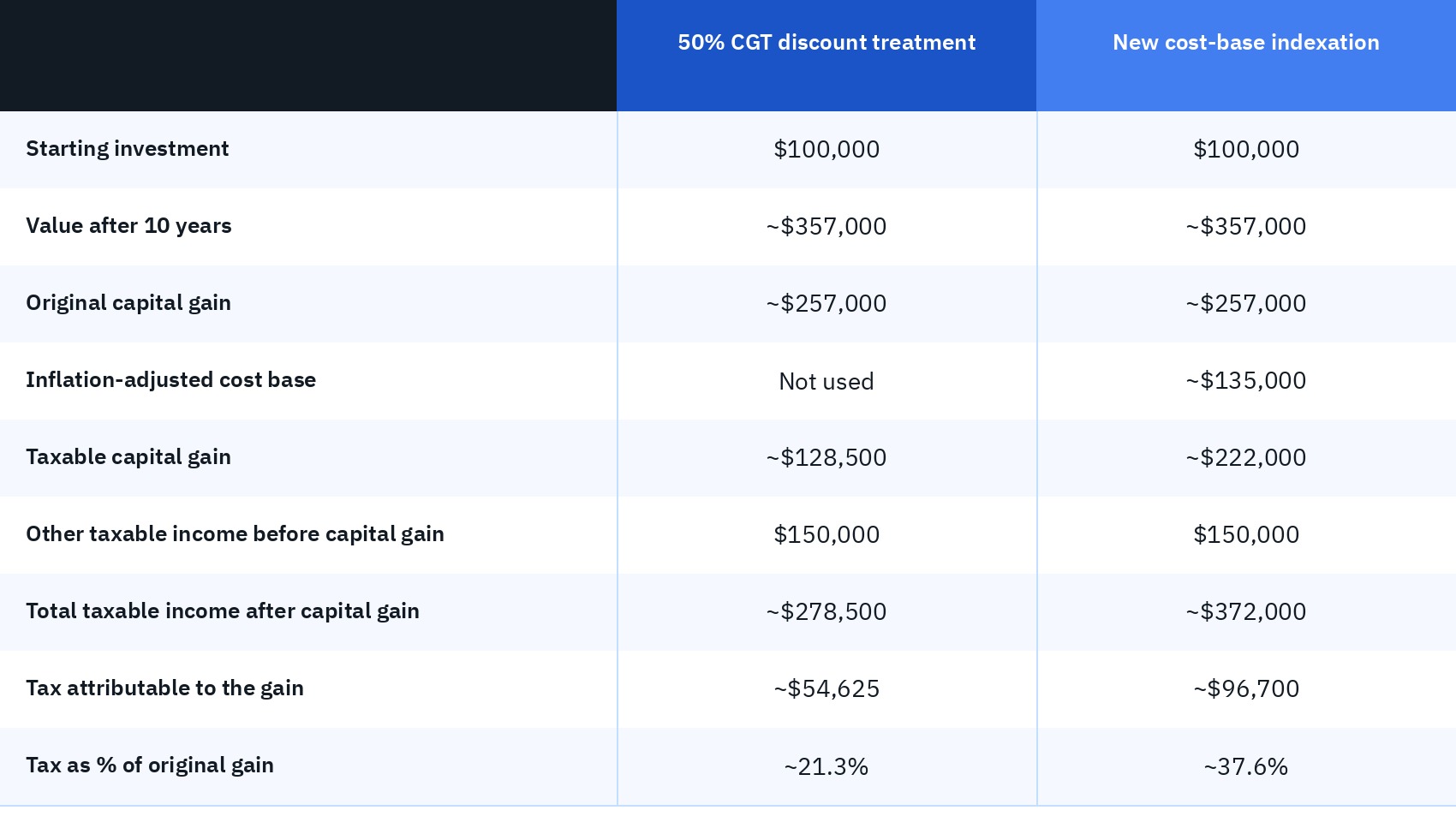
How the tax calculation works
Because the investor already has $150,000 of other taxable income, the first $40,000 of each taxable capital gain takes taxable income up to $190,000 and is taxed at 37%. Any remaining taxable gain falls above $190,000 and is taxed at 45%.
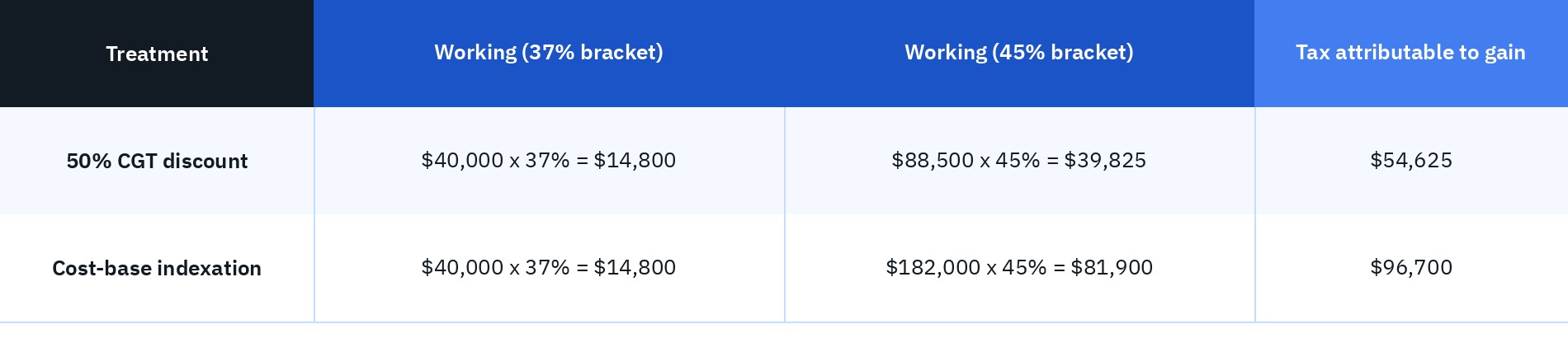
The investor is not simply charged 45% CGT. In this simplified example, different parts of the taxable capital gain are taxed at the marginal rates they fall into. Under the 50% CGT discount treatment, the tax attributable to the gain is approximately $54,625. Under cost-base indexation, it is approximately $96,700.
That is equivalent to approximately 21.3% versus 37.6% of the original $257,000 nominal gain in this example. This does not assume the next decade will repeat the last. Historical returns and inflation are used only to illustrate the difference between the two tax treatments. When investment growth runs substantially ahead of inflation, indexation can leave considerably more of the gain exposed to tax than the previous 50% discount.
Assets you already hold: how the transition actually works
For assets already held on 1 July 2027, transitional rules separate gains accruing before that date from gains accruing afterwards. The new indexation treatment does not simply apply to the entire historical gain.
Qualifying new residential property also has special rules, including the ability to choose between the 50% CGT discount and the new indexation treatment.
Negative gearing is changing too
From 1 July 2027, negative gearing is restricted for affected established residential properties acquired after 7:30pm AEST on 12 May 2026.
Take a $700,000 established apartment with:
- Rental income: $28,000
- Deductible interest and expenses: $52,000
- Annual loss: $24,000
At the 45% top marginal tax rate, excluding Medicare levy, deducting that loss against salary could provide an immediate tax benefit of up to $10,800.
From 1 July 2027, an affected investor can no longer use that loss against non-residential income such as salary.
The loss doesn't disappear. It can be applied against relevant residential property income, with unused amounts carried forward subject to the rules.
Established residential properties held before the 7:30pm AEST, 12 May 2026 cut-off retain their existing treatment, while qualifying new builds can continue to be negatively geared.
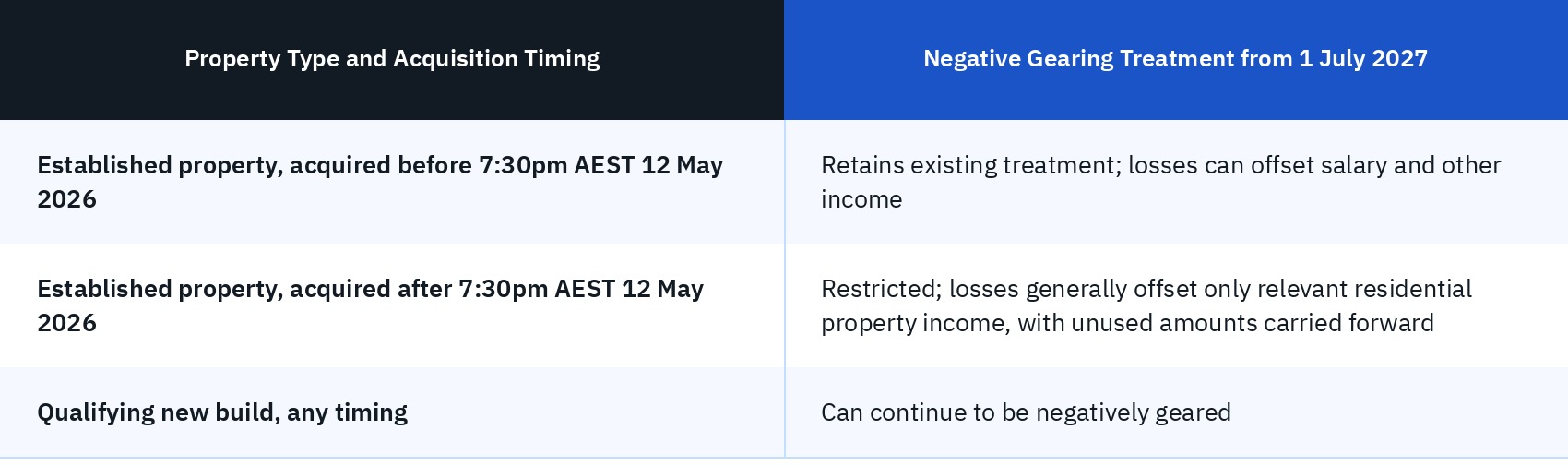
That means the tax economics of an established investment property can now differ depending on when it was acquired, and when selling, the new buyer will not be able to negatively gear it. This could be a potential market effect worth watching, particularly around demand for established resale properties, though the actual impact will depend on broader market conditions.
Multiple properties, multiple rules
For investors who hold more than one established property, the acquisition-date cutoff can leave a genuinely fragmented tax position. A property bought in 2022 might retain full negative gearing, while an established property bought in late 2026 or after may not. Two similar properties in the same portfolio, both generating a loss, could now be treated completely differently depending only on their purchase date. This is worth reviewing property by property rather than assuming the treatment is uniform across a portfolio, particularly ahead of any future purchase or sale decisions.
For Australians living overseas, timing matters
Becoming an Australian resident for tax purposes can bring worldwide income and certain capital gains within the Australian tax system.
Special rules can apply to assets already held when residency begins, depending on individual circumstances and applicable tax treaties.
If you're planning to return to Australia, reviewing your investments and structures before becoming an Australian tax resident can therefore be important.
A few practical next steps
For investors this could affect, worth considering:
- Check acquisition dates against the 12 May 2026 negative gearing cutoff and the 1 July 2027 CGT transition date for every asset you hold.
- If you hold assets across the 1 July 2027 transition, speak to your Australian accountant or tax adviser about the transitional rules and what valuations or records may be appropriate for your circumstances.
- If you hold multiple established properties, review each one individually rather than assuming uniform tax treatment across the portfolio.
- If you're planning to return to Australia and resume tax residency, review your investment structures before that residency begins rather than after.
I have experience as a financial adviser in Australia and now work with clients internationally, including Australians living overseas and considering a return home.
If Australia is part of your future and you'd like to understand the financial planning implications of these changes, send me a message at bendavis@melbournecapitalgroup.com or connect with me on Linkedin.
Australian tax implications should be considered with an appropriately qualified Australian tax professional.
Sources
Australian Treasury, Budget 2026–27 tax system changes https://treasury.gov.au/policy-topics/taxation/budget2026-27
Australian legislation, Treasury Laws Amendment (Tax Reform No. 1) Act 2026 https://www.legislation.gov.au/C2026A00049/latest/text
Income Tax Rates Act 1986, Schedule 7, resident individual tax rates for 2027-28 and later https://www.legislation.gov.au/C2004A03348/latest/text
S&P Dow Jones Indices, S&P 500 Index https://www.spglobal.com/spdji/en/indices/equity/sp-500/
The S&P 500 example uses the 13.58% annualised price return for the 10 years to 30 June 2026.
Australian Bureau of Statistics, Consumer Price Index, Australia https://www.abs.gov.au/statistics/economy/price-indexes-and-inflation/consumer-price-index-australia
The approximately 35% cumulative inflation figure is based on ABS CPI data over the corresponding historical period and is intentionally presented as an approximate figure for this illustrative scenario.
Important information: This content is general information only and does not take into account your objectives, financial situation or needs. Examples are simplified and illustrative. Actual tax outcomes depend on individual circumstances and applicable law, including other taxable income, capital losses, deductions, tax offsets and applicable concessions. Examples exclude purchase and transaction costs, other cost-base adjustments, fees, distributions, currency movements, Medicare levy and other taxes unless stated otherwise. Past performance is not indicative of future performance. Obtain appropriately qualified financial and Australian tax advice before acting. Financial planning services in Malaysia are provided subject to applicable Malaysian regulation and relevant licences and authorisations.
.webp)
Explore our Insights
Our team of global experts share their perspective on markets and news from the company.
.webp)


.jpg)