
.jpg)
Disclaimer: This article is for general information and education only. It does not constitute financial, investment, tax, or legal advice, and should not be relied upon as such. Any examples are illustrative and not guarantees of future results. Consider seeking advice from qualified professionals based on your personal circumstances.
As a new mum, I've found myself thinking about my son's education far earlier than I ever expected. Before he's even started school, I'm already asking: where do I want him to go? What experience do I want him to have? And honestly, can we make it work financially?
For most expat families, private or international schools aren't a luxury; they're often the only viable option. And the costs stretch beyond tuition: uniforms, books and materials, transport or school bus fees, extracurriculars, examination fees, and sometimes accommodation (for boarding or overseas study).
What I have come to realise, as both a mum and a Chartered Financial Planner, is that this isn't just about crunching numbers. It's about giving your child the best possible start, while being honest about your annual budget, smart about what you put away now before school age, and mindful that your future self and your life today matter too.
.jpg)
Key Takeaways
- Start saving and investing early; compounding does the heavy lifting
- Plan for the full cost, not just tuition
- Match your investment strategy to your timeline (short vs. long-term)
- May help reduce the impact of inflation over time
- Family support is a bonus, never the foundation
- Use cashflow modelling to stress-test your plan, fees rising, currency shifting, and family growing, before life catches you off guard
- Review your plan annually; life changes, your plan should too
When should parents start saving for education fees?
The sooner you begin setting aside funds, the more time your savings or investments have to grow. Even modest monthly contributions, especially over 10–15 years, can result in a substantial education fund.
This is where compounding plays a crucial role. Compounding works by earning returns on your initial investment, and then earning returns on those returns, creating a snowball effect that accelerates growth over time. Even modest monthly contributions of USD115 over 10–15 years can result in a fund that far exceeds what you've actually put in.
Here's the difference in numbers: If a family saved USD115/month from birth to age 18 and earned a hypothetical 6% p.a. return (with returns varying over time), the balance could be in the region of ~USD45k. If they started at age 8 with the same contribution, it could be closer to ~USD19k. The difference highlights how time in the market can matter, but returns are not guaranteed and actual outcomes will vary1.
Starting late requires much larger monthly contributions to achieve the same result, making it harder to balance other financial goals, such as retirement or property.
Click here to understand more about the "power of compounding."
Disclaimer: Investments can fall as well as rise. Returns are not guaranteed. Exchange rates can increase or reduce the value of savings and investments when fees are paid in a different currency.
What costs should be included in education planning?
When estimating how much you need to save, don't just consider tuition. Include extras: books, uniforms, transport, school trips, extracurricular programs, exam fees, possible boarding costs, and even living expenses (if studying abroad). If you foresee overseas university or boarding school, remember that costs and currency exchange may shift. Also, keep in mind inflation and fee increases. School fees, especially in private and international settings, typically increase 3-7% annually, often outpacing general inflation.
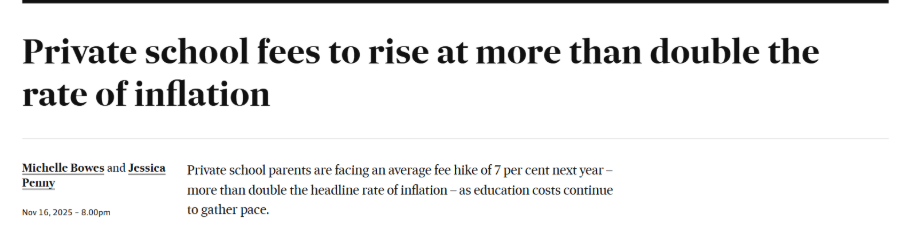
By accounting for the complete picture, not just headline tuition, you ensure your education fund truly covers your child's needs without financial stress.
How to combat rising education costs?
The right savings or investment approach depends on three key factors: your time horizon until fees are due, your risk tolerance and where tuition will be paid (Malaysia or abroad). Each timeline requires a different strategy to balance growth potential with capital protection.
- For short-term (next 1–5 years); use conservative instruments such as savings accounts or fixed-term deposits.
- For medium-to-long term (5–15 years+): it’s possible to invest money in portfolios of liquid funds, it may help diversify currency exposure and may help reduce the impact of inflation over time.
- For expats: consider multi-currency or internationally oriented investment or savings plans, which may help manage currency exposure where income and fee currency differ.
Should families rely on grandparents or extended family to support education fee funding?
It isn't uncommon for families to rely on extended family to help fund education, especially grandparents. This can significantly ease the burden, and in both the UK and US, there are meaningful tax incentives that make such contributions even more compelling.
For example, in the UK, grandparents can contribute to a child's education as part of their inheritance tax planning: gifts made from surplus income are immediately exempt from the 40% inheritance tax, and lump-sum gifts of up to £3,000 per year fall under the annual exemption.
In the US, grandparents can superfund a 529 education savings plan with up to five years' worth of the annual gift tax exclusion in a single contribution, currently up to USD90,000 per beneficiary, removing that amount from their taxable estate and shielding it from the federal estate tax.
For grandparents with sizeable estates, funding education isn't just generosity; it's smart estate planning. But this support should still be treated as a "bonus," not the foundation of your plan. Tax rules change, family circumstances shift, and willingness can waver. Build your strategy on what you can control and let family contributions be a welcome addition, not a load-bearing wall.
Click here to learn more about UK inheritance tax.
Disclaimer: Tax rules are complex and can change. Any tax commentary is general and may not apply to your situation, please consult a qualified tax adviser.
.jpg)
How can expats tailor an education plan?
- Clarify your long-term education goals — Local school, international private school, overseas university, boarding school? Each option may have wildly different costs and currency exposures. This determines how much you need to save.
- Map out a multi-currency funding strategy (if needed) — If you’re earning, say, in MYR but paying fees in USD, GBP or SGD, using multi-currency savings or investment solutions helps guard against exchange-rate swings.
- Protect broader family financial goals — Education savings should not overshadow retirement funds, emergency reserves, or other priorities. A balanced approach helps ensure long-term financial security. Remember - you must put your life jacket on first!
- Review periodically — Revisit your plan annually (or when there’s a change in income, currency, or schooling plan) to adjust contributions or investment mix. This helps you stay on track despite inflation, school fee changes or life events.
- Involve grandparents or extended family where appropriate — Where families are open to contributing, structured support (e.g. regular contributions) can supplement your core plan, but always base your main financial strategy on what you can commit.
How can cashflow modelling support education fee planning?
Cashflow modelling can be a helpful planning tool. Rather than working out rough estimates, it builds a dynamic, visual picture of your financial future, mapping your income, outgoings, savings, and investments against the projected timeline of school and university fees. It can support decision-making, but it relies on assumptions and should be reviewed as circumstances change.
It's also central to how I work with every client. I don't start with products or portfolios. I start with your story. Where are you now, where do you want to be, and how does your child's education fit alongside everything else you're working towards? From there, we build a living model that we revisit together as life changes.
For expat families in particular, this matters enormously. A good cash flow model can stress-test your plans against real-world assumptions: what happens if school fees rise 5% annually? What if your home currency weakens against the host currency? What if you have a second child two years later? These scenarios can be modelled before they happen, giving you the visibility to support your final decision.
Crucially, cashflow modelling also shows how education funding sits alongside your other financial goals - retirement, property, and emergency reserves. So, you're never optimising one at the expense of the other. It turns abstract numbers into a coherent, holistic plan.
To learn more about cashflow modelling, click here.
Common mistakes in education planning?
- Under-estimating total costs: Many families consider only tuition, ignoring uniforms, books, transport, boarding, extracurriculars, and living costs. That’s a recipe for shortfall.
- Over-relying on uncertain family help: Grandparents or relatives may wish to offer financial help, but if their circumstances change, you could be left scrambling. Build your plan based on your ability first.
- Ignoring currency risk as an expat: If tuition is in a different currency from your income, exchange-rate fluctuations can dramatically shift costs. Plan for that.
- Waiting too long to start saving or investing: The longer you wait, the bigger the monthly contribution needed, which may conflict with other financial goals.
- Failing to revisit the plan regularly: Life changes, schooling choices, family size, job, location, so your savings and investment plan should evolve too.
Final thoughts: A holistic, multigenerational approach
Education funding is rarely a single transaction; it's a thread woven through a family's entire financial story. As a Chartered Financial Planner who works closely with expat families, I've seen how those who approach it strategically, starting early, planning for real costs, investing with purpose, and building in flexibility for inflation and currency shifts, are able to give their children and grandchildren extraordinary opportunities without sacrificing their own financial security in the process.
The families who get this right don't do it by saving harder. They do it by planning smarter.
Helen Thomas is a UK Chartered Financial Planner, now based in Johor, helping expat families across the region navigate the complexities of cross-border financial planning. If you’d like to explore what an education funding plan could look like for your family, Helen welcomes a conversation to understand your goals and share how the planning process works. Any next steps would be based on your circumstances and (where relevant) in coordination with your legal and tax advisers. Connect with her on Linkedin or email her at helenthomas@melbournecapitalgroup.com
.webp)
Explore our Insights
Our team of global experts share their perspective on markets and news from the company.
.webp)


.jpg)