
.jpg)
UK State Pensions Changes for British Expats: What You Need to Know
From 6th April 2026, British expats can no longer pay voluntary Class 2 National Insurance contributions for periods spent living abroad. Most who remain eligible must now pay the significantly more expensive Class 3 rate instead, and new applicants must also meet a 10-year UK residency or contribution test. For the roughly 453,000 British pensioners currently abroad whose State Pension is already frozen at the rate first paid, the April 2026 triple lock increases passed them by entirely. Together, these changes make reviewing your National Insurance record and State Pension forecast more urgent than it has been in years.
Table of Contents
- Key Takeaways
- What Has Changed From April 2026?
- What If You Were Already Paying Voluntary Contributions?
- Why is the UK State Pension Important?
- Is Topping Up Worth It? Advantages & Disadvantages
- Could Your State Pension Be Frozen Overseas?
- Why Planning Matters?
- A Simple Example
- A Holistic Approach to Retirement Planning
- What Should British Expatriates Do Now?
- FAQs
Key Takeaways
- From 6 April 2026, the lower-cost Class 2 voluntary National Insurance route for expats is closed. Most eligible people must now pay Class 3, which is more than five times the old rate, and new applicants must meet a ten-year UK residency or contribution test.
- You need 35 qualifying years for the full new State Pension of £241.30 per week, and at least 10 qualifying years to receive anything at all.
- If you live in Malaysia or most of Asia, Australia, Canada, or South Africa, your State Pension is frozen at the rate first paid. Annual triple-lock increases will not apply, materially changing whether topping up makes financial sense.
- Paying does not automatically increase your pension. Contracted-out service and your existing record can mean an additional year adds nothing. Confirm with HMRC before making any payment.
- Transitional deadlines apply. If you were previously paying voluntary contributions, the window to protect your position may close as early as April 2027.
- The State Pension is one part of a broader picture; how it sits alongside private pensions, SIPP consolidation, the NT tax code, and your wider retirement income strategy matter as much as the contribution decision itself.
What Has Changed From April 2026?
.jpg)
For many British expatriates, the UK State pension remains an important part of their retirement planning. However, changes introduced from 6th April 2026 affect the voluntary National Insurance contributions that people living overseas can make to build or protect their future State Pension entitlement.
From 6th April 2026, access to Class 2 National Insurance contributions for periods spent living or working abroad outside the UK was closed. Those who remain eligible will generally need to pay Class 3 contributions instead, at £18.40 per week for the 2026/27 tax year, considerably more than the former class rate of approximately £3.50 per week.
New applicants wishing to pay voluntary class 3 contributions for periods abroad will generally need to demonstrate either ten consecutive years of UK residence or at least 10 qualifying years of National Insurance contributions. National Insurance credits and most voluntary contributions previously paid for overseas periods do not normally count towards this test, meaning some who left the UK earlier in their careers may no longer qualify at all.
This makes it increasingly important to understand your National Insurance record before relocating abroad and review it promptly if you are already overseas.
What If You Were Already Paying Voluntary Contributions?
Transitional arrangements may apply to some people who had existing voluntary National Insurance arrangements before 6th April 2026. People who were already paying voluntary Class 3 contributions for periods abroad may generally continue to do so under the previous eligibility rules. Some who were previously eligible to pay the lower Class 2 rate may also apply to pay the higher Class 3 rate under transitional arrangements, provided they meet the relevant conditions and apply within the required timeframe. The transitional deadline may be as early as 5th April 2027, depending on individual circumstances.
Anyone who previously paid voluntary contributions from overseas should check their position with HMRC promptly, rather than assuming their existing arrangement continues automatically.
Why Is the UK State Pension Important?
The new State Pension can provide a valuable foundation for retirement income. While it is unlikely to meet all retirement needs on its own, it provides an income for life and can complement private pensions, investments, savings and other retirement assets. To receive the full state pension of £241.30 per week, you generally need 35 qualifying years of National Insurance contributions and at least 10 qualifying years to receive any State Pension at all.
Moving abroad does not mean losing access to UK pension entitlements, but it does change how they work. State Pension entitlement is based on your UK National Insurance record, not your country of residence. UK nationals can receive State Pension payments while living abroad, wherever in the world they are based. Private and workplace pensions continue to be held in the UK after you leave, but decisions around contributions, tax treatment, and eventual drawdown become more complex once you are no longer a UK resident.
The tax picture also shifts. Where a double taxation agreement exists between the UK and your country of residence, such as the UK-Malaysia DTA, it determines which jurisdiction has the right to tax your pension income, and how much tax you pay on your UK pension in your country of residence. In some cases, applying for an NT (No Tax) code can allow a UK pension to be paid gross from the UK and assessed under local rules instead.
For some expatriates, making voluntary national insurance contributions represents an attractive long-term value where the payment results in a meaningful increase in State Pension entitlement. However, contributions should not be made automatically. It is important to confirm that an additional qualifying year will genuinely increase your forecast State Pension before making any payment.
Pension planning can be quite complex, and we can conduct a pension review, helping create a full picture of your pension savings, and if beneficial, work to consolidate your savings.
Read more: UK pensions abroad
Is Topping Up Worth It? Advantages & Disadvantages
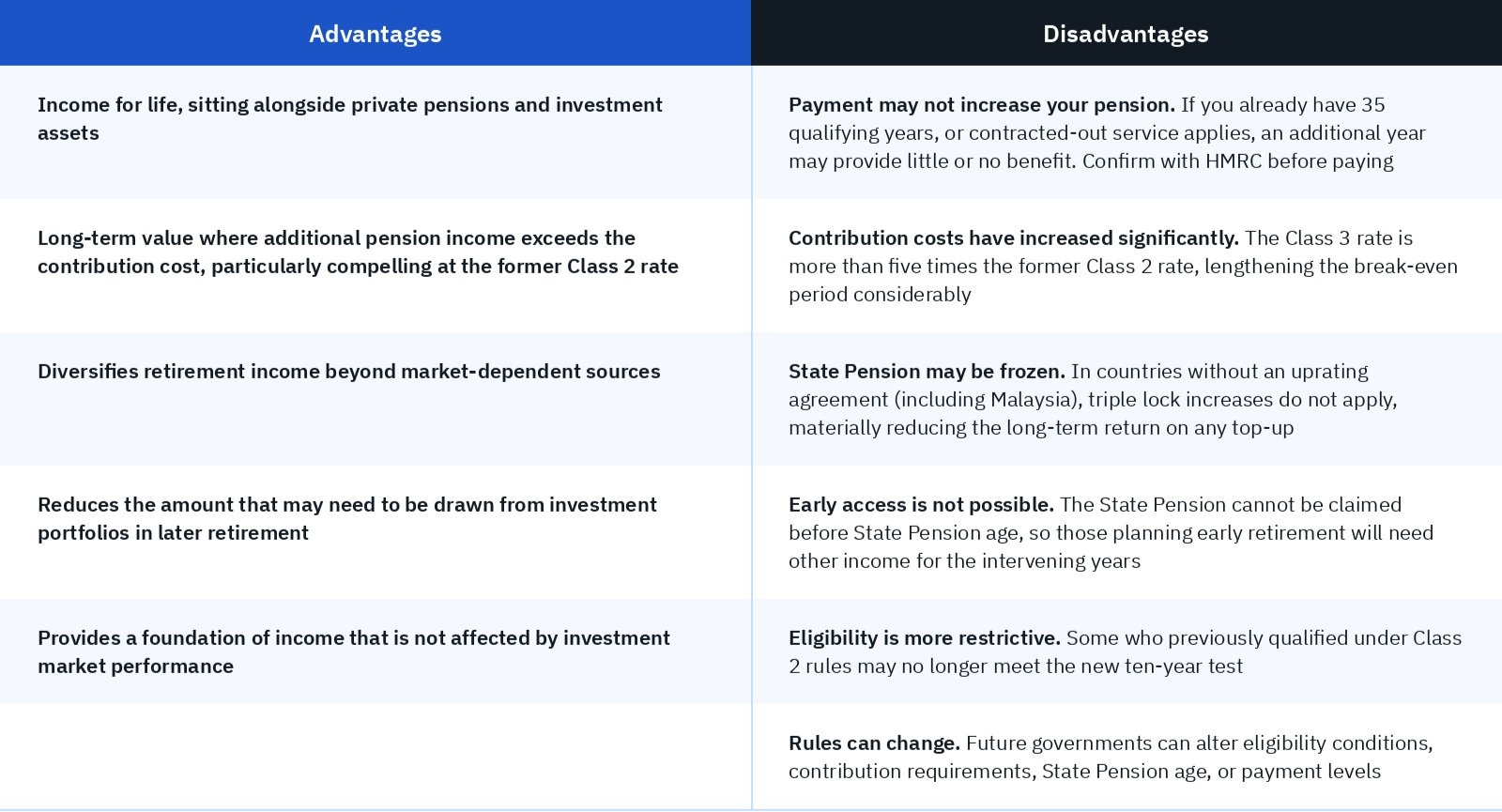
Whether voluntary contributions make sense depends on your individual circumstances. The potential value will depend on the amount paid, the resulting increase in State Pension, your tax position, life expectancy, and whether annual increases are payable in your country of residence. The table below sets out the key considerations on both sides.
The right answer depends on your specific National Insurance record, planned country of retirement, and wider financial picture. Confirming the benefit with HMRC before making any payment is essential in all cases.
Could Your State Pension Be Frozen Overseas?
The UK State Pension rises each April under the triple lock, whichever is highest of average earnings growth, CPI inflation or 2.5%. That represents a meaningful rise in income for those who receive it. However, of the roughly 1.1 million Brits drawing State Pension overseas, around 453,000 received no increase at all because they live in a country without a reciprocal uprating agreement with the UK. Their pensions remain fixed at whatever level applied when they first claimed or moved abroad.
Expats retiring to a frozen country can miss out on approximately £70,000 over a 20-year retirement, based on current figures. Countries where annual increases are paid include the European Economic Area, Gibraltar, Switzerland, and certain countries with social security agreements. Countries where pensions are frozen include Australia, Canada, New Zealand, South Africa, and most of Asia, including Malaysia. For UK nationals in frozen countries, the pension is fixed at the rate applicable when they first reach State Pension age or move abroad, whichever is later.
For British expats in Malaysia specifically, the State Pension is frozen at the rate at which it was first claimed. This is a significant planning consideration that affects the break-even calculation on any voluntary top-up and should be factored into retirement income projections. The GOV.UK country list confirms where annual increases are paid.
The State Pension can be claimed from abroad through the International Pension Centre, no earlier than four months before reaching State Pension age. You will need your National Insurance number to complete the claim. It is paid in sterling, which introduces currency risk for expats spending in another currency; the real value received will vary with exchange rate movements over time.
Why Planning Matters?
One of the most common mistakes British expats make is leaving it until they are approaching retirement to review their State Pension position. By that point, options may already be narrower than they were.
The temporary extension that allowed many people to fill gaps dating back to the 2006/07 tax year ended on 5 April 2025. In most circumstances, individuals can now only make voluntary contributions for the previous six tax years. Each passing year may be irretrievable, and transitional deadlines for former Class 2 payers may fall as early as April 2027.
A proper review should include:
- Checking your National Insurance record
- Obtaining an up-to-date State Pension forecast
- Identifying gaps in your National Insurance contribution record and establishing whether filling them takes you closer to the 10 qualifying years needed for any State Pension, or the 35 years needed for the full pension
- Establishing whether you remain eligible under the post-April 2026 overseas rules
- Confirming whether paying for an additional year will actually increase your pension
- Understanding the relevant contribution cost and potential break-even period
- Considering whether your State Pension will receive annual increases in your chosen country of retirement
- Reviewing how the State Pension fits into your wider retirement strategy
A Simple Example
Suppose an expatriate has several gaps in their National Insurance record and is forecast to receive less than the full new State Pension of £241.30 per week.
If paying for one additional qualifying year increases their annual State Pension, the initial cost may be recovered after a number of years of receiving the higher pension. However, this calculation depends on the cost of the voluntary contribution, how much additional State Pension it provides, the individual's tax position, their life expectancy, the age at which they can claim, and, critically, whether the pension will be updated annually in their country of retirement.
For an expat in Malaysia, where the pension is frozen, this final factor significantly changes the long-term return on any top-up. Checking the forecast and confirming the benefit before paying is essential in all cases.
A Holistic Approach to Retirement Planning
The UK State Pension should be viewed as one part of a broader financial picture, not the whole of it.
Many expats also hold private pension pots accumulated across former UK employers, often left in default investment strategies built for a UK resident that may no longer reflect their current risk profile, time horizon, or currency requirements. A periodic review of how these assets are invested is as important as understanding when and how to draw them.
Read more: The hidden cost of ignoring your previous UK workplace pension.
For expats with multiple deferred defined contribution pots, consolidating into a SIPP may provide cleaner oversight and greater drawdown flexibility. An international SIPP designed for non-UK residents can also accommodate multiple currencies and jurisdictions more cleanly than a standard UK scheme. For defined benefit pensions, the decision is different; guaranteed benefits and protected pension ages can be lost on transfer, and anyone considering transferring a defined benefit pension worth more than £30,000 is required by the FCA to take regulated financial advice first.
Read more: How a financial adviser can help with UK pension transfers.
What Should British Expatriates Do Now?
- Identify any incomplete or missing contribution years
- Confirm whether you satisfy the post-April 2026 overseas eligibility rules
- Establish whether any transitional arrangements apply to your situation
- Contact HMRC to confirm the benefit before making any voluntary payment
- Review the State Pension alongside your wider pensions, investments, and retirement income plan
Those who were previously paying voluntary Class 2 or Class 3 contributions from abroad should act particularly promptly, as transitional deadlines may apply as early as April 2027.
UK pension rules change more frequently than many expats realise, and what applied when you left the UK may no longer apply today. At Melbourne Capital Group, I help expatriates build coordinated financial plans that consider UK pensions, international investments, wealth management, estate planning, and protection together, so that each element works toward the same long-term goals rather than in isolation.
If you have any questions about your pension, insurance, or investments, you may email reach out to Adam Humphries at adamhumphries@melbournecapitalgroup.com or connect with him on Linkedin.
Disclaimer: This article is provided for general information and educational purposes only and does not constitute financial, investment, legal or tax advice, nor is it a recommendation to take any particular course of action. The information is based on legislation and guidance available at the time of publication, which may change without notice. Individual circumstances differ, and readers should seek independent professional advice, including legal and tax advice where appropriate, before making any financial decisions. Any financial services provided by Melbourne Capital Group are subject to the scope of the firm's applicable regulatory licences and the laws of the relevant jurisdictions.
FAQs
- Can I still top up my State Pension from abroad after April 2026?
Voluntary contributions remain possible for most eligible expats, but the Class 2 route is now closed for overseas periods from 2026/27 onwards. Most eligible individuals must pay Class 3 contributions at the higher rate, and new applicants must also meet either a 10-year UK residency or a contribution test. Transitional arrangements may apply if you were already paying voluntary contributions before April 2026; check with HMRC before making any assumptions.
- Will my State Pension increase each year if I retire in Malaysia?
Malaysia does not have an uprating agreement with the UK. The State Pension will be paid but remains frozen at the rate first applicable when you claim or move there; annual triple lock increases will not apply. This should be factored into long-term retirement income projections and affects the break-even calculation on any voluntary top-up.
- How do I know if paying for an additional year is worth it?
Check your State Pension forecast and National Insurance record through GOV.UK, then confirm with HMRC that an additional qualifying year will actually increase your forecast; it does not always do so, depending on the contracted-out service and your existing record. The break-even period also changes significantly depending on whether your pension will be uprated in your country of retirement.
- Should I transfer my UK pension to an international SIPP?
For defined contribution pots, consolidation into a SIPP can provide cleaner oversight and greater drawdown flexibility. For defined benefit pensions, the decision requires careful analysis; guaranteed benefits and protected pension ages can be lost on transfer, and FCA rules require regulated financial advice before transferring any defined benefit pension worth more than £30,000.
Read more: How a financial adviser can help with UK pension transfers.
- What is an NT tax code, and can I use it for my UK pension?
An NT (No Tax) code allows a UK pension to be paid gross from the UK, with tax assessed under the rules of your country of residence instead. Where a double taxation agreement exists between the UK and your country, such as the UK-Malaysia DTA, this can be meaningfully more efficient than having tax withheld in the UK. Eligibility and the application process require professional advice.
Read more: NT Tax code guide for non-UK residents.
.webp)
Explore our Insights
Our team of global experts share their perspective on markets and news from the company.
.jpg)

.jpg)
.jpg)