

How Does International Life Insurance Work For Expats?
If you live or travel across borders, your family's safety net needs to go with you. International life insurance is built to do exactly that; it is designed to pay a specific sum to your beneficiaries, no matter which country you are in, when the unexpected happens, closing a gap many domestic policies leave wide open.
Your premium is based on four factors: the level of cover you choose, your age, your health, and your lifestyle. The real question isn't whether to get covered; it's how much and how it should be structured for your family's needs.
Table of Contents
- Key Takeaways
- What is International Life Insurance?
- What Types of International Life Insurance Are Available for Expats?
- How Does International Life Insurance Differ from a Domestic Policy?
- Who Needs International Life Insurance?
- How is the Premium Calculated?
- How Much Coverage Do You Need?
- Keeping Life Insurance Outside Your Estate
- What are the Risks and Limitations of Life Insurance?
- FAQs
Key Takeaways
- International life insurance is designed to pay out regardless of where you live or travel, subject to the policy's terms and conditions. Many domestic policies don't extend that far.
- Term life insurance is a common, flexible structure for expats, often matched to a specific window like a child reaching adulthood.
- Premiums depend on coverage amount, age, health, and lifestyle factors.
- Coverage needs are best mapped across short, medium, and long-term horizons rather than picked as a single round number.
- Structure matters as much as the amount. A trust may help keep life insurance proceeds outside your estate, while owning the policy outright may result in them forming part of your taxable estate.
What is International Life Insurance?
International life insurance is an agreement where an insurance company pays a specified amount, the death benefit, to your beneficiaries upon your passing. For expats specifically, it creates a gap that domestic policies may leave open: coverage that doesn't automatically extend to events occurring outside your home country.
Where a domestic policy is written around the assumptions of one jurisdiction, residence, regulation, and currency, an international policy is designed to follow the policyholder across borders. The distinction matters the most when you live abroad permanently, move frequently, or hold assets and dependents across more than one country.
Life Insurance also plays a role in estate planning, used correctly, a policy can fund a tax liability, provide liquidity during probate, or ensure beneficiaries have immediate access to funds without waiting for an estate to be settled. The structure in which the policy is held helps determine whether it achieves that goal.
What Types of Life Insurance Are Available for Expats?
International Term Life Insurance
Term life insurance provides coverage for a fixed period and pays the death benefit only if the policyholder passes away during that term. Once the term ends, coverage ceases and no cash value remains.
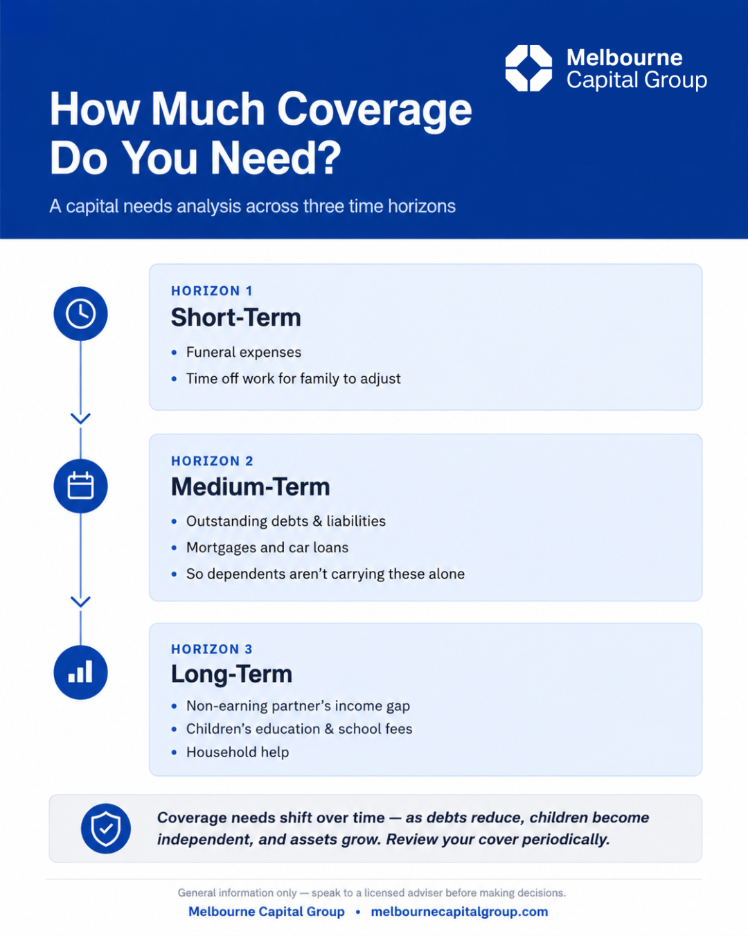
The term length should be tailored to the period when cover is actually needed not defaulted to a round number. For example, to match a mortgage term or parent with a newborn, may be better served by an 18-year policy designed to run until the child is financially independent, rather than a standard 10-, 15-, or 20-year term that may expire too early or run longer than necessary. The goal is to ensure that a loss of income doesn't create financial risk for dependents during the years they're most vulnerable, and the term should be built around that window specifically.
For expats specifically, term life is one of the most cost-effective structures available and because international policies are portable, the cover travels with you regardless of where you're based when the term runs.
International Whole of Life Insurance
Whole life insurance provides lifetime coverage and typically includes a cash value or investment linked component that builds over time. Premiums are generally higher than term life, but the policy remains in force for the policyholder's lifetime provided premiums are paid, and the accumulated cash can sometimes be accessed or borrowed against.
For expats with multi-jurisdictional estate planning needs, such as providing long-term liquidity for an estate across multiple countries or funding an inheritance tax liability, whole life structures can be worth considering alongside term options.
Other Structures
Beyond term and whole life, some international policies blend elements of both. Universal life insurance, for example, allows you to adjust both the premium amount and death benefit level over time, and may include an investment component where part of the premium is allocated to a fund.
How Does International Life Insurance Differ from a Domestic Policy?
Understanding the differences helps clarify why a domestic policy may not be sufficient when you travel abroad.
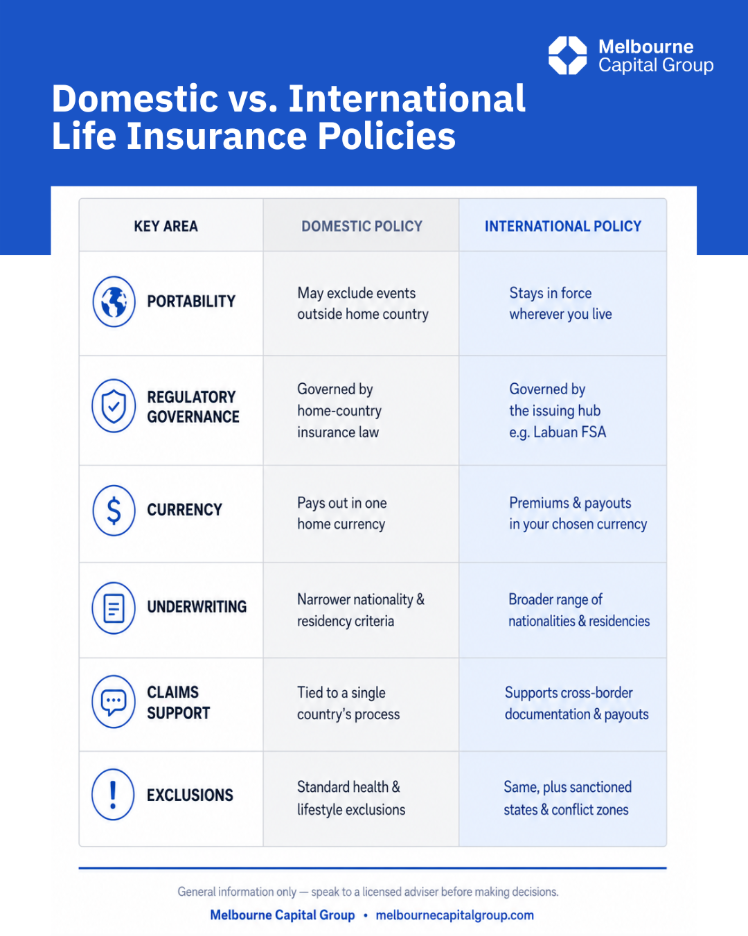
1. Portability - International policies are designed to remain in force regardless of where the policyholder resides or travels. Many domestic policies contain residency clauses or geographic exclusions that can affect claims for events occurring outside the home country, sometimes without the policyholder realising until a claim is made.
2. Regulatory governance - Domestic policies are regulated by the home country's insurance authority and written under local law. International policies, particularly those issued through Labuan or other offshore insurance hubs, operate under a different regulatory framework, which affects how claims are processed, how disputes are resolved, and what statutory protections apply. For example, Labuan FSA-regulated policies are governed under the Labuan Financial Services and Securities Act 2010.
3. Multi-currency premiums and payouts - International policies often allow premiums to be paid and benefits received in a currency that suits the policyholder's circumstances, reducing the currency mismatch that arises when a domestic policy pays out in a currency different from where dependents live and spend.
4. Underwriting across jurisdictions - International insurers typically underwrite across a broader range of nationalities, residency situations, and countries of travel than domestic insurers, including clients who would be declined or restricted by a home-country provider due to overseas residence.
5. Claims Support - International policies generally offer claims support that is not tied to a single country's process, which matters when a claim involves documentation across jurisdictions or beneficiaries in multiple countries.
6. Exclusions for high-risk locations - Most international policies include exclusions for sanctioned states and active conflict zones. Coverage terms vary by insurer, and confirming territorial exclusions before purchasing is an important step, particularly for clients who travel to higher-risk regions for work.
It is important to note that coverage is subject to the policy's terms and may exclude sanctioned states and active conflict zones.
Who Needs International Life Insurance?
- Parents: For internationally mobile families, education costs extend well beyond the basics. Attending an international school in a hub like Kuala Lumpur through to completing a UK university degree can realistically cost more than £447,000 in tuition alone. Single parents carry this consideration even more directly, since children depend on a single income.
To learn more about the cost of education abroad, click here.
- Couples: Many households rely on two incomes to maintain their standard of living. Life insurance closes the gap a sudden loss would otherwise leave in debts, funeral costs and daily expenses.
- Homeowners: For most people, a home is the most valuable asset and the mortgage the largest liability. Cover set against the value of the mortgage is intended to help a family retain the home rather than face the liability alone, though, as with any policy, the actual benefit paid depends on the policy being in force and its terms being met.
- Estates with potential inheritance tax or death duties: Life insurance can be a cost-effective way to fund a tax bill without forcing a sale of other assets, provided it's held in the right structure; otherwise, the payout simply adds to the taxable estate rather than covering it.
If you are a UK resident, click here to find out more about UK inheritance tax.
- Individuals without dependents: If you support parents or siblings, or carry debt you wouldn't want passed on, life insurance is still a useful tool even without a spouse or children of your own.
- Those with assets in multiple jurisdictions: Where an estate spans multiple countries, a life insurance payout can provide immediate liquidity for beneficiaries while the wider estate administration proceeds through probate across jurisdictions, which can take considerably longer than a domestic process.
- Expats relocating to or from high-risk regions: Those moving to regions with limited access to domestic insurance markets or with a history of frequent relocation benefit from a portable policy that doesn't require re-underwriting with each move.
How is the Insurance Premium Calculated?
Regardless of policy type, the premium is generally driven by:
- The monetary value of the coverage selected
- Your age
- Your health, assessed through a medical declaration and, in some cases, a medical exam
- Lifestyle factors, such as whether you smoke or engage in high-risk activities
Premiums for international life insurance are typically higher than domestic cover due to broader portability, multi-currency capability and the insurer's exposure across a wider range of territories. The gap varies by age and health profile, so obtaining quotes across multiple providers is worthwhile before committing.
How Much Coverage Do You Need?
There is no universal answer here; the right amount depends on individual goals and circumstances, which is where sitting down with an advisor to map out case needs against existing resources adds value. A useful way to frame it is across three time horizons, following the capital needs analysis approach commonly used in life insurance planning.
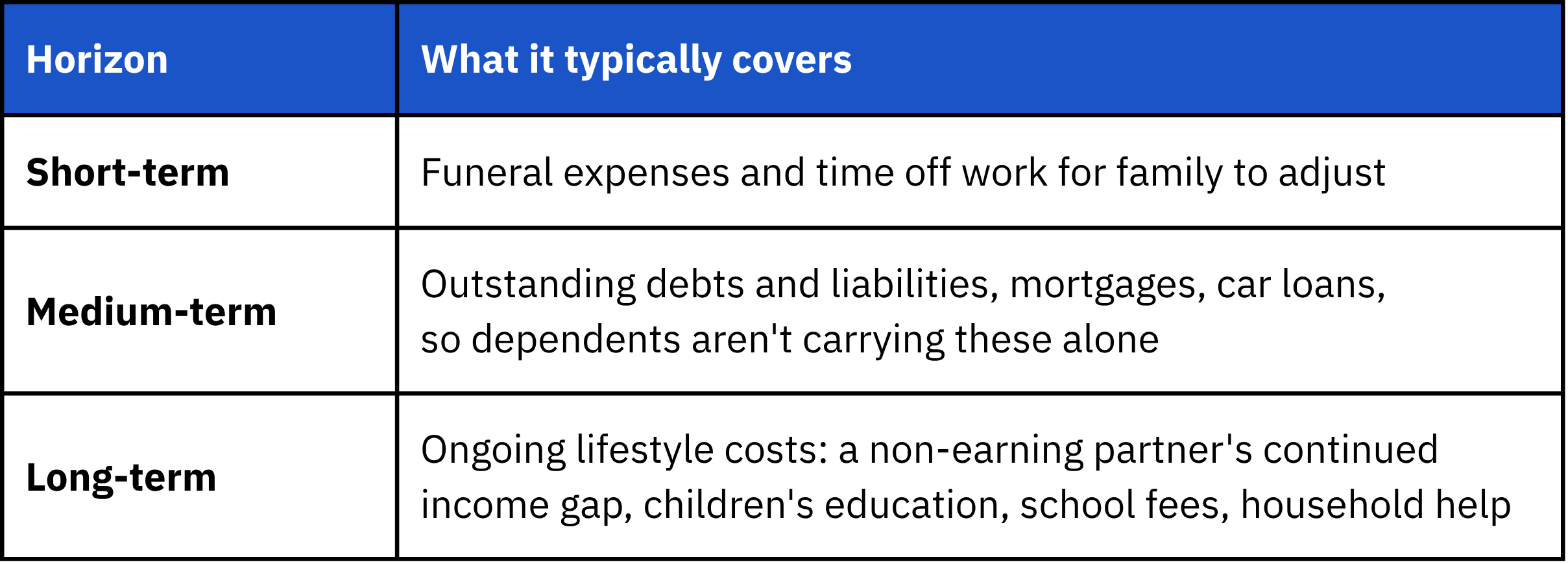
This framework also connects directly to the estate planning process: the total coverage needed shifts as debts reduce, children become independent, and assets grow, which is why reviewing coverage periodically, not just at the point of purchase, matters.
Keeping Life Insurance Outside Your Estate
A life insurance payout intended to cover inheritance tax or death duties only works as intended if it's structured correctly. Owned outright, the payout is typically counted as part of the taxable estate, which can mean it simply increases the very liability it was meant to offset.
One structure used to address this is a trust, where the trust, rather than the individual, owns and is the beneficiary of the policy. Done correctly, this keeps the proceeds outside the taxable estate and gives beneficiaries faster access to funds without waiting on probate. The trade-off is control: once assets are placed in certain trust structures, the terms generally can't be changed without the trustee's or beneficiaries' agreement, so it's a decision worth making with full visibility into what's being given up.
For expats with assets across multiple jurisdictions, the interaction between life insurance, trust structures, and legacy planning adds a further layer, particularly where different countries apply different rules to trust ownership of insurance policies.
Read more: Succession planning with multi-jurisdictional assets
What are the Risks and Limitations of Life Insurance
Life insurance is a contract with conditions attached, not an unconditional guarantee. A few things worth understanding before taking out a policy:
- Underwriting and disclosure: Coverage and premiums depend on the health and lifestyle information declared at application. Inaccurate or incomplete disclosure can affect a claim later.
- Lapses and exclusions: A policy generally ends if premiums stop being paid, and most policies include specific exclusions (for example, certain pre-existing conditions or high-risk activities) that limit when a payout applies.
- Currency and jurisdiction: Cross-border policies can involve currency risk and differing tax or regulatory treatment depending on where you and your beneficiaries are based.
- No guaranteed returns on cash-value products: Where a policy includes an investment or savings component, any illustrated growth is a projection, not a guarantee, and actual performance can be lower.
- Limited statutory protection: International policies issued offshore may not carry the same statutory compensation or protection schemes available to domestic policyholders in the home country. Confirming what protections apply under the issuing jurisdiction before purchasing is worthwhile.
We can help walk through how these apply to a specific policy and circumstances.
Ready to Review Your Coverage?
Have you reviewed your Expat insurance coverage this year? Cover that made sense when you first moved abroad often doesn't reflect where you are now. A new country, a growing family, more assets to protect.
I work with expat clients across Malaysia every day on exactly this question: not just whether you're covered, but whether the structure still fits. If it's been a while since you looked at your policy, I'd be glad to walk through it with you. Connect with me, Daniel Lees, on Linkedin or email me at daniellees@melbournecapitalgroup.com.
FAQs
1. Will my existing domestic life insurance policy cover me while living abroad?
Coverage varies by insurer and policy. Many domestic policies include residency clauses or geographic exclusions that can affect events occurring outside the home country, sometimes without the policyholder realising until a claim is made. Checking the policy wording or moving to a policy specifically designed for expats, means you're not left discovering the gap only once a claim is being filed.
2. What is the difference between term life and whole life insurance for expats?
Term life covers a fixed period and is generally lower-cost, making it well suited to a specific financial window, a mortgage term, the years until children are financially independent, or a period of peak income and debt. Whole life stays in force for the policyholder's lifetime and typically builds cash value, which suits different goals such as estate liquidity or long-term wealth transfer. The right structure depends on what the policy is meant to achieve within the broader estate and legacy plan.
3. Does life insurance count toward my taxable estate?
A policy owned outright by the insured individual is generally included in the taxable estate in most jurisdictions. Holding the policy through the right trust structure is one way to keep the proceeds outside the estate, which is why ownership structure matters as much as coverage level, and is best reviewed alongside broader estate planning advice.
4. What exclusions should I look out for in an international policy? Most international policies include exclusions for sanctioned states, active conflict zones, and certain pre-existing health conditions or high-risk activities. The exact exclusions vary by insurer and policy. Reviewing the full terms, including territorial restrictions, before purchasing is important, particularly for clients who travel frequently or work in higher-risk regions.
This article is for general information purposes only and does not constitute financial, tax, or legal advice. It does not take into account your personal objectives, financial situation, or needs. You should seek advice from a licensed adviser before making any decisions regarding insurance or financial planning. Melbourne Capital Group Ltd is a licensed insurance broker regulated by Labuan FSA.
.webp)
Explore our Insights
Our team of global experts share their perspective on markets and news from the company.
.jpg)

.jpg)
.jpg)