What Budget 2027 Means
Thanga Velu, Private Wealth Manager, reviews what Budget 2027 entails.
Budget 2027 is broadly speaking a quiet budget for most high earners with modest changes including; the two middle tax bands falling by a percentage point, personal relief rising to RM12,000 and the 30% top rate now starting at RM1 million of chargeable income. With dividend tax, capital gains tax on unlisted shares, EPF and PRS all remaining unchanged.
For expat families, however, there is one genuinely significant change. From 1 January 2027, dependent spouses of Category 1 Employment Pass holders will be allowed to work in Malaysia, subject to conditions. For many households, that could mean a second income for the first time since relocating.
For business owners, while this Budget introduces relatively few new tax incentives, it does signal continued support for investment especially in artificial intelligence, high-technology industries and green technologies.
For me, the real value for most clients probably won’t be found in the headlines, but in claiming what they are already entitled to.
In this article I am going to cover off;
- What this budget means for your tax position
- What it means for household spending
- Effects on EPF and PRS
- What it means for business owners
- What it means for the ringgit
- Expat Visas – important changes
- My top tips
Is your tax position changing?
From Year of Assessment (YA) 2027, the RM70,001–RM100,000 band drops from 19% to 18%. A new RM100,001–RM150,000 band is taxed at 24% instead of 25%. Chargeable income above RM1 million is taxed at 30%.
Take a client with RM500,000 of chargeable income. The two band cuts save roughly RM800 a year. However, for someone on RM1.5 million, the picture reverses. The 30% rate previously applied only above RM2 million, so income between RM1 million and RM2 million moves from 28% to 30%. On RM1.5 million, that is around RM10,000 more tax, or roughly RM9,200 net of the band cuts.
If your income sits above RM1 million, it may therefore be worth talking to your tax adviser about the timing of bonuses, director's fees or dividends between 2026 and 2027.
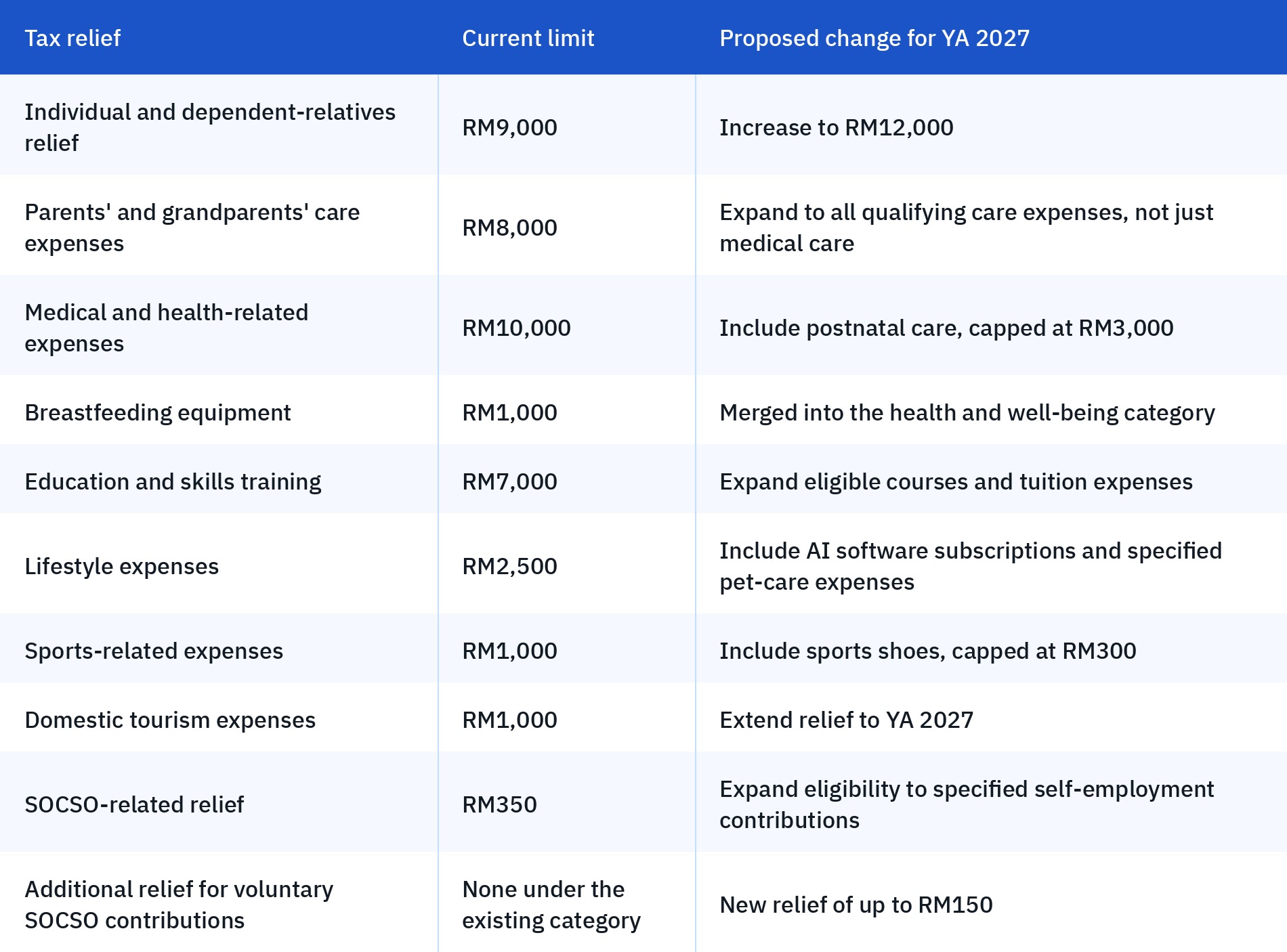
The main relief changes are as follows, all effective from YA 2027:
The chargeable income tax reduced on the:
RM70,001–RM100,000 from 19% to 18%
RM100,001–RM150,000 from 25% to 24%
No changes to the dividend tax or capital gains tax (CGT) on unlisted shares were announced in Budget 2027.
For me the most meaningful change is the wider parents' and grandparents' relief. This will be especially pertinent to those supporting ageing relatives, as it now covers day-to-day care, not just medical bills.
However, as with any relief, it only helps if it is claimed, and that depends on having the receipts to support it.
While these new reliefs will not take effect until next year, it is worth reviewing those already available to you. With the year end approaching, check which reliefs you may be eligible for and gather the supporting documents now, so you are ready to make a complete and accurate claim.
What does it mean for household spending?
cash assistance for lower- and middle-income households. There is no return to blanket fuel subsidies; targeted petrol support under BUDI95 continues, with eligibility and monthly quotas.
For higher-income families, the fuel quota is the one subsidy likely to make a noticeable difference to personal inflation. It is worth checking your eligibility rather than assuming. One SST change matters for families supporting elderly parents: from 1 January 2027, registered elderly care is exempt on fees up to RM96,000 per person a year, with 6% service tax above that.
Were there changes to EPF and PRS?
The Government left both the EPF and Private Retirement Scheme (PRS) framework untouched with maximum EPF contribution holding at up to RM100k and PRS RM3,000 tax relief maintained. It means for those who have yet to utilise their annual RM3,000 PRS tax relief, there is a clear opportunity to save. To give an example at a 26% marginal rate, a fully eligible RM3,000 deduction could reduce income tax by approximately RM780.
It’s worth noting however, that while EPF and PRS are good savings tools, they are not a retirement plan in themselves. Learn more about retirement planning.
What does this budget mean for Ringgit?
The 2026 deficit is now estimated at 3.6% of GDP, slightly above target, with the government aiming for 3.3% in 2027. Government debt stands at roughly RM1.38 trillion, and annual borrowing of around RM77 billion is still needed.
Both S&P (A−, reaffirmed 29 September 2026) and Moody's (A3, July 2026) maintain investment-grade ratings with a stable outlook. Malaysia remains creditworthy, but fiscal risks have not gone away.
For those who need foreign currency for future education, retirement or offshore investments, it’ is prudent to do staged conversions. Currency diversification can also help reduce the risk of relying on a single exchange-rate level.
Any changes to foreign income?
Treatment of foreign-sourced income also remains unchanged on the continued conditional exemption that generally the income must have been taxed in its country of origin or fall within the Inland Revenue Board's guidelines. This said, it must still be declared in your Malaysian return, with supporting documents kept.
What changed for business owners?
This is a budget more focussed on MSMEs. As Anand Cheillah, Managing Partner, Tax Services at Baker Tilly, commented in its Budget Highlight Report; “One of the notable aspects of Budget 2027 is its continued emphasis on supporting MSMEs, recognising their significant contribution to the economy and their role in generating employment and sustaining business activity.”
From YA 2027, the MSME rate falls from 15% to 14% on the first RM150,000 of chargeable income, and from 17% to 16% on the next band up to RM600,000. The small-value asset allowance rises from RM2,000 to RM3,000 per asset, and accelerated capital allowances on plant, machinery and ICT equipment are extended to 2030.There is no change to capital gains tax on unlisted shares.
While the reduction in MSME tax rates, enhanced capital allowances and higher small-value asset threshold will improve cash flow for many SMEs, business owners should view these measures as an opportunity to undertake broader strategic planning. This includes ensuring e-Invoice compliance while relief periods remain available, quantifying the tax savings that could be achieved under the new rules, and assessing whether investments in technology, machinery or equipment should be brought forward. Owners should also take the opportunity to obtain an up-to-date business valuation, review the tax position of their shareholdings, and reassess the most effective ways to extract wealth from the business, whether through dividends, remuneration or shareholder loan repayments. For those contemplating succession or an eventual sale, early reviews of ownership, legal and tax structures can help avoid costly surprises and ensure any future transfer of shares or business interests is undertaken as efficiently as possible.
It’s also worth noting that investors gain two new incentives from 1 January 2027 to 2030: income tax exemptions for angel investment in technology start-ups and for investment in MSMEs through equity crowdfunding, subject to conditions. So, for businesses in this space looking to generate capital, now might be a good time to start thinking about getting that investment.
Changes for expats
For expat families, the most significant change this year has nothing to do with tax rates. From 1 January 2027, dependent pass holding spouses of expatriates who hold a Category I Employment Pass will be allowed to work in Malaysia, subject to conditions that are yet to be set out in detail. For many households this could mean a second income for the first time since relocating. Separately, existing DE Rantau Nomad Pass holders who have reached the two-year limit will be able to stay and work remotely for a further two years, again subject to conditions. Finally, for those on MM2H visa there were no changes.
Top tips
- Update your records monthly. Keep receipts, statements and payment confirmations for every eligible contribution and expense.
- Use your YA 2026 reliefs before 31 December. PRS, lifestyle, medical, education and domestic tourism reliefs do not roll over.
- Plan around the RM1 million threshold. If your income is near or above it, review the timing of bonuses, fees and dividends with your tax adviser.
- Check your BUDI95 eligibility. Confirm your fuel quota rather than assuming it applies or doesn't.
- Business owners: keep e-Invoicing current. Track deadlines, exemptions and transitional arrangements, and get a qualified tax consultant involved early.
- Stage your currency moves. Convert gradually for future offshore needs rather than reacting to one announcement.
- Before spending, check what you’ll actually save. Lifestyle relief is only worth claiming on purchases you were already planning to make. At a 26% marginal rate, a RM3,000 lifestyle spend returns around RM780 in tax savings, so buying something purely for the relief rarely makes financial sense
Turning Budget changes into long-term progress
Budget 2027 may be relatively quiet for many higher earners, yet it still creates practical opportunities to strengthen your position; whether by claiming the reliefs already available to you, keeping the records needed to support them, reviewing income around the RM1 million threshold or making full use of long-term savings allowances. The key is not to react to each announcement in isolation, but to consider how it fits into your wider tax, investment, retirement and protection strategy. A well-maintained financial plan, reviewed regularly and adjusted as your circumstances change, is how you turn modest policy changes into meaningful progress and achieve those long-term financial goals.
If you would like to understand what Budget 2027 means for you, get in touch with me at thanga@melbournecapitalgroup.com or connect with me on Linkedin.
This article is for general information only and does not constitute financial advice and should not be construed as such. Outcomes depend on individual circumstances, and independent, professional advice should be sought before making any financial decision.

Explore our Insights
Our team of global experts share their perspective on markets and news from the company.