
The Birth of AI: We Are Living Through the Most Consequential Technological Shift of Our Lifetimes

There are moments in history that only reveal their significance in retrospect. The printing press. The industrial revolution. The internet.
Each transformed how economies function, how capital is allocated, and where wealth is ultimately created.
We believe artificial intelligence is the next chapter in that story.
Unlike previous technological revolutions, however, we have the unusual advantage of recognising it while it is unfolding. What began as a breakthrough in machine learning is rapidly becoming a structural reorganisation of the global economy. The evidence is no longer confined to research laboratories or technology conferences, it is now visible in global capital markets.
The AI IPO Supercycle Has Arrived
During institutional meetings in New York earlier this year, one question repeatedly surfaced:
"When do the AI companies go public?"
That question is now being answered.
Anthropic, creator of Claude, has confidentially filed for an IPO. OpenAI is widely expected to follow. Meanwhile, SpaceX, now incorporating Elon Musk's xAI business following its merger earlier this year, is preparing what could become the largest IPO in history.
Together, these businesses represent hundreds of billions of dollars in potential market capitalisation and fundraising activity. Goldman Sachs recently forecast record US IPO issuance in 2026, and AI companies are expected to account for a significant proportion of that activity.
For years, investors seeking AI exposure have largely relied on indirect beneficiaries such as Nvidia, Microsoft and Alphabet. The arrival of publicly listed AI leaders changes that dynamic entirely.
This is more than a pipeline of new listings. It is the emergence of artificial intelligence as a standalone public-market asset class.
Why This Cycle Is Different
Investors have seen technology booms before, and comparisons with the dot-com era are inevitable.
However, several factors distinguish today's AI leaders. The revenues are real. These businesses are generating billions of dollars from enterprise contracts, subscriptions and infrastructure services today, not relying solely on future adoption assumptions.
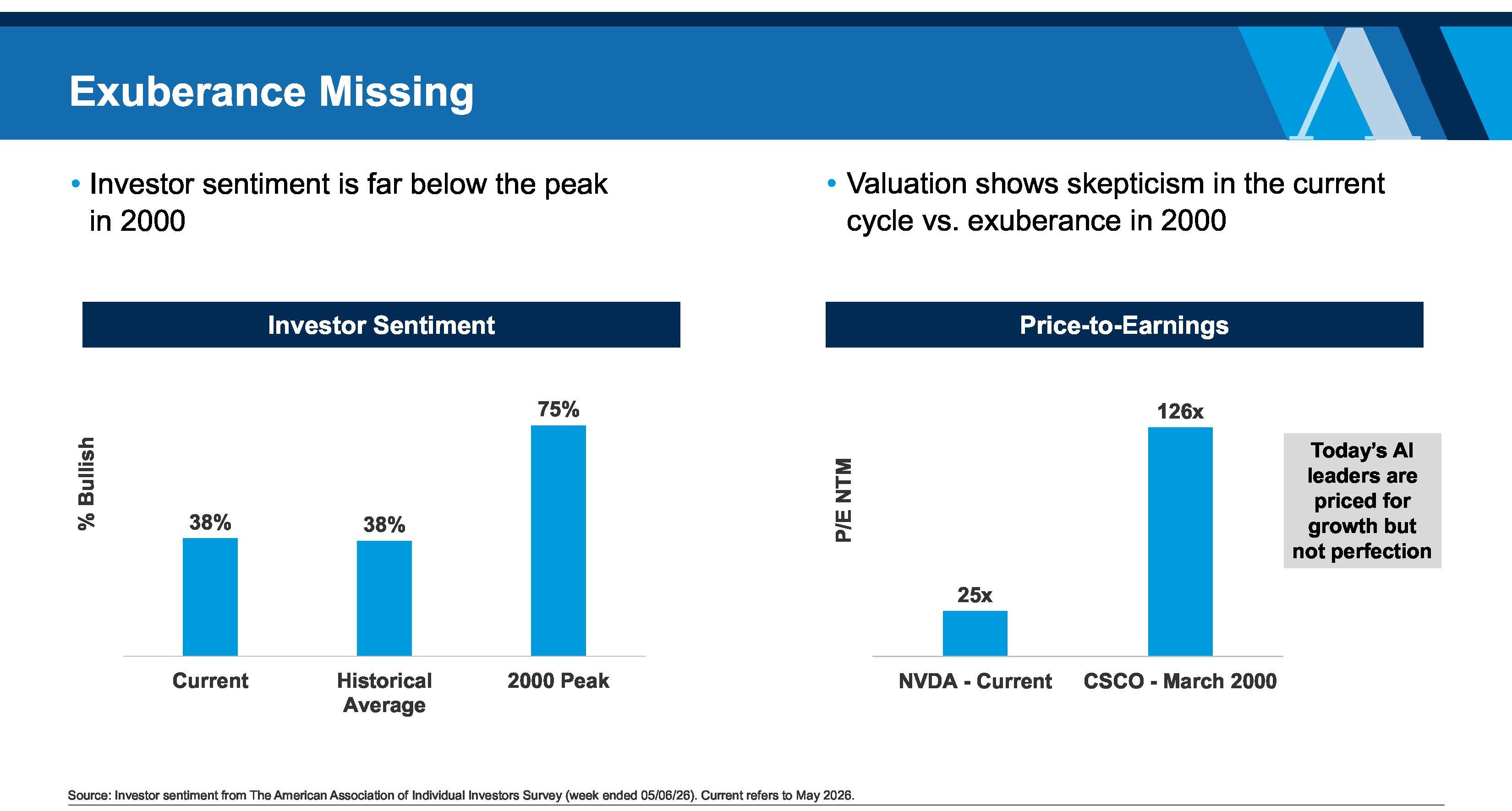
During our recent webinar co-hosted with Alger, Brad Neuman, Senior Vice President and Director of Market Strategy at Alger, addressed the valuation question directly. Pointing to Nvidia's current trading multiple compared with Cisco at the peak of the dot-com bubble, he noted:
"Nvidia traded around 25 times forward 12-month earnings, right in line with the S&P 500. Compare that with Cisco, the bellwether of the internet, which traded around 126 times forward earnings. That stock was clearly priced for perfection. So if today's price action looks anything like the late 90s, sentiment and valuations look nothing like the peak in 2000."
The barriers to entry are also substantial. Frontier AI requires vast investments in computing power, specialised chips, data centres and energy infrastructure, making these increasingly infrastructure businesses rather than traditional software companies. And institutional demand remains largely untapped. Direct access to the companies building AI itself is likely to attract significant global capital once public listings become available.
The Investment Question That Matters
For investors, the key question is not simply whether AI will be transformative.
It is where value will ultimately be created.
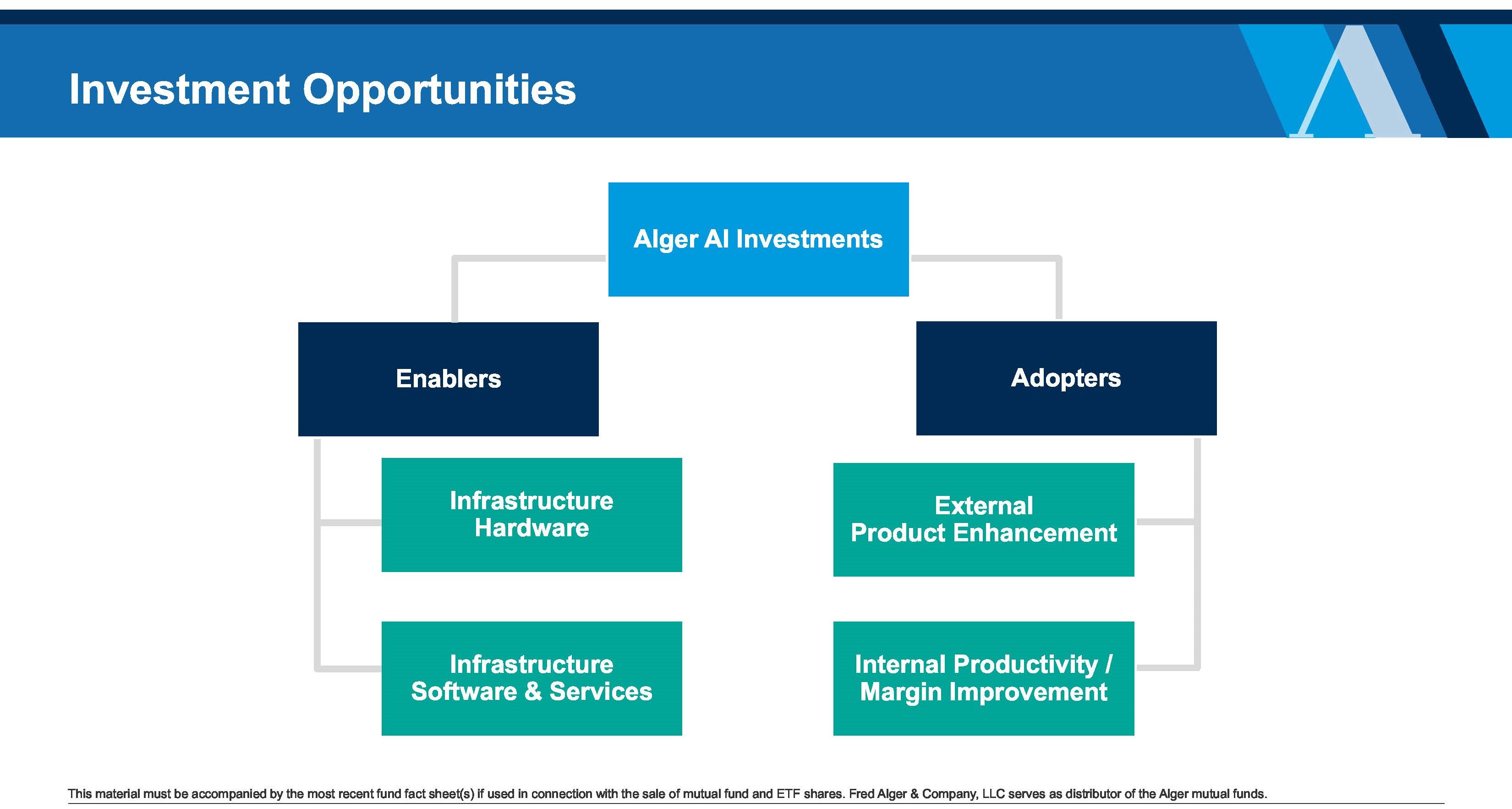
Alger approaches this through a framework they call Enablers and Adopters, a distinction Brad Neuman explained during the webinar:
"AI enablers are the companies that build the infrastructure to allow others to use artificial intelligence; the chips, servers, cooling equipment, data centres, cloud service providers and large language models. Adopters are the companies putting AI to work, either through external product enhancement, making their products more valuable to customers, or through internal productivity and margin improvement."
Alger's view, shared during the session, is that enablers have been the largest stock market beneficiaries so far, but that this will shift over time:
"As long as we're compute-constrained, enablers are probably in the driver's seat. But once there's enough compute, and companies can use all the AI they want if they're willing to pay for it, you'll see more synergies with their businesses. The adopters will carry more of the returns."
History suggests the greatest opportunities are not always found in the most visible companies. During previous technological revolutions, wealth was created across entire ecosystems. Artificial intelligence may prove no different.
AI in Use Today
It is easy to talk about AI in abstract terms. What does it look like in practice?
Brad Neuman offered several examples during the webinar. The most significant, perhaps, is the recursive nature of AI's impact on its own development:
"The number one place where AI is being used today is in coding itself, which means AI is becoming recursive. It is beginning to write itself. 90% of Claude's Code software is written by Claude Code itself. More than half of Google's code is now written by AI agents. Meta is producing at least half of its code with AI agents and is dramatically increasing engineer productivity by 30 to 80%."
Beyond software development, the commercial applications are broadening rapidly. In advertising, AI is enabling platforms to serve the right ad at the right time; improving returns for advertisers and increasing revenue for media companies. In healthcare, the implications are potentially more profound still. Brad noted the progress of a Moderna customised cancer vaccine trial:
"They're sequencing each individual's cancer through AI and designing an mRNA therapy to attack that cancer. AI could revolutionise cancer treatment, drug discovery, and a lot in healthcare."
Human-Powered AI
At Melbourne Capital Group, our interest extends beyond the companies themselves.
We are equally focused on how artificial intelligence can improve outcomes for clients.
AI is already transforming research, portfolio analysis, scenario modelling and operational efficiency. Properly utilised, it allows advisers to process information faster, identify opportunities more effectively, and provide more informed recommendations.
However, there is an important distinction.
AI should enhance advisers, not replace them.
Wealth management is ultimately a human business. Clients are rarely solving simple investment problems. They are navigating business sales, succession planning, cross-border tax considerations, family dynamics and multi-generational wealth decisions.
These situations require judgement, experience and context.
Technology can improve the quality of advice. It cannot replace the human understanding that sits at the centre of it.
At Melbourne Capital Group, we believe in human-powered AI, not AI-powered humans. The technology makes our advisers better informed and more efficient. The relationship, accountability and judgement remain firmly human.
Watch the Webinar Recording
On 10 June 2026, Melbourne Capital Group co-hosted a live webinar with Alger “Artificial Intelligence: Mapping the Investment Opportunity”, bringing together Brad Neuman, Senior Vice President and Director of Market Strategy, and Chrisopher Conte, Vice President of Marketing at Alger, alongside our own adviser, Luke White, to explore the infrastructure, companies, and investment themes shaping the AI revolution.
The full recording covers the Enablers vs. Adopters framework in depth, the data centre buildout, AI adoption across sectors, the upcoming AI IPO cycle, sovereign AI outside the US, and ESG considerations around data centre power consumption.
Click the image below to request access to the recording,
.png)
This article is for informational and educational purposes only and does not constitute investment advice. Melbourne Capital Group recommends seeking independent financial advice tailored to your individual circumstances before making any investment decisions. Melbourne Capital Group Sdn. Bhd. is an Approved Financial Adviser under Bank Negara Malaysia.
.webp)
Explore our Insights
Our team of global experts share their perspective on markets and news from the company.
.jpg)

.jpg)
.jpg)