
A trust is a legal entity that holds assets on behalf of a beneficiary and carries instructions for how and when those assets are managed and distributed. Where a trust is in place, the assets held within it generally bypass the probate process in many jurisdictions, which may allow them to pass to beneficiaries more efficiently. However, probate or ancillary grant requirements vary by jurisdiction and asset class, and cross-border estates may still require local court procedures in certain countries. Unlike a will, which names who receives money, a trust determines how, when, and under what conditions they receive it.
This article focuses on beneficiary trust and how it addresses a gap that a will alone cannot close for expats with minor children, offshore savings plan, or assets spread across jurisdictions.
In this Article
- Key Takeaways
- Meet David
- The Gap Nobody Warned Him About
- What Is a Trust and How Does It Work?
- Wills vs Trusts: Key Differences
- How David Structured His Trust
- What a Trust Changes in Practice
- Things Worth Knowing Before Setting One Up
- Is a Trust Right for Your Plan?
- Glossary
- Frequently Asked Questions
Key Takeaways
- A will names who gets the money. A trust controls how, when, and under what conditions they receive it. For minor beneficiaries, that distinction matters enormously.
- Without a trust, a lump sum paid to a child under 18 goes to a court-appointed administrator until they turn 18, then releases in full with no conditions. That is the default outcome a will cannot override.
- With a trust, distribution is staged according to the settlor's own instructions. Education funded when needed. A portion at 21. The balance at 25. David's intentions, not a court's default, determine the outcome.
- Nothing changes during the settlor's lifetime. The plan continues in your name, you retain full control, and the beneficiary trust is dormant until it is needed.
- Trustees can be based overseas. Their location only matters when the trust activates. During the settlor's lifetime, only their own signature is required for day-to-day plan management.
- A trust works alongside a will, not instead of one. Both documents serve different purposes. Both are needed as part of effective estate planning.
- Revocable trusts can be updated or cancelled at any time while the settlor is alive. The structure moves with your circumstances, not against them.
Meet David
David is 44, South African, and has been living and working in Kuala Lumpur for eight years as a project manager in the oil and gas sector. He is divorced. His 12-year-old daughter, Leila, lives with her mother in Cape Town.
Over the years, David has been quietly building up an offshore savings plan. Not for retirement, for Leila. His intention has always been clear: fund her university education, give her a financial foundation as she moves into adult life, and ensure that if something happened to him, she would be taken care of. He has a will. It names Leila as the beneficiary of the plan. He has done what most people would consider the responsible thing, and for many expats, this is where inheritance planning stops. What David did not know was that the will, however carefully written, could not actually deliver what he intended.
Disclaimer: David is a composite case study created for illustrative purposes only. He does not represent a real client of Melbourne Capital Group, and any resemblance to real individuals is coincidental. Figures and scenarios used are for demonstration purposes and are not projections or personalised recommendations.
The Gap Nobody Warned Him About
When David's adviser sat down to review his financial plan, they raised something he had not considered.
A will names who receives the money. It does not control the distribution or the timing of the transfer of assets. And where the named beneficiary is a minor, the law steps in to fill that gap, on its own terms, not yours.
Under Malaysian law, when a minor is named as a beneficiary of assets situated in Malaysia.
Those assets cannot generally be transferred directly to minor. Where the beneficiary, trustees or assets are located in other jurisdictions, such as South Africa or United Kingdom, the laws of those jurisdictions will also apply and may impose different requirements
The court must appoint a trustee to hold the assets on behalf of the child until the child reaches the age of 18. At that point, the assets are released in full, with no conditions, no staging, and no instructions about what the money is for. Court-supervised guardianship of this kind terminates when the child turns 18, handing them a large lump sum at that point with no further conditions attached.
David's intention was never to hand Leila a lump sum at 18. He was building this for her education, her university years, a financial foundation she could grow into. The will he had carefully put in place could not deliver that, not because it was poorly written, but because a will is structurally not designed to control distribution. It is designed to name a recipient. The gap is not one most people are warned about. For expats managing wealth across jurisdictions, careful planning is required to close it before it becomes a problem.
What Is a Beneficiary Trust and How Does It Work?
In practice, a beneficiary trust at its core, it is a legal arrangement that holds assets on behalf of a beneficiary and carries instructions for how those assets are managed and distributed. A beneficiary trust is specifically designed to pass the proceeds of a plan to named beneficiaries upon the death of the plan owner, without requiring probate. It is distinct from a will trust (created within a will), a probate trust (used to manage assets through probate), and a discretionary trust (where the trustee has discretion over distribution). Understanding which trust type applies to your situation matters.
There are three roles:
The Settlor is the person who creates the trust and provides the assets that go into it. In David's case, that is David.
The Trustee is the individual or organisation legally responsible for managing the assets in accordance with the instructions set by the settlor. The trustee acts in the interests of the beneficiary, not their own.
The Beneficiary is the person who ultimately benefits from the trust. In David's case, that is Leila.
Wills vs Trusts: Key Differences
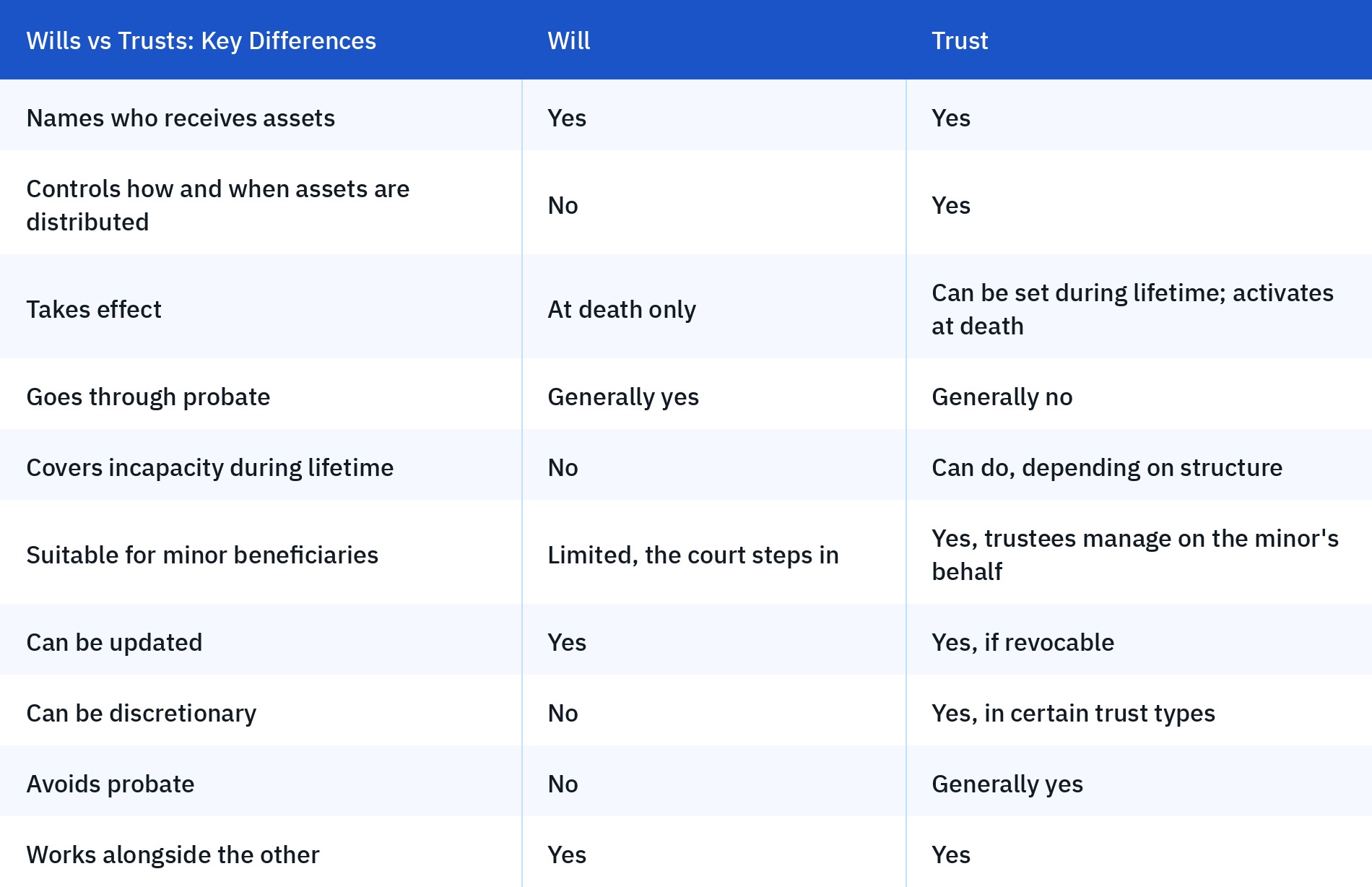
A trust works alongside a will, not instead of one. Both documents serve different purposes, and both remain necessary as part of a complete estate plan.
Read more: Importance of International Wills for Expatriates
How David Structured His Beneficiary Trust
Once David understood the gap, the decisions he needed to make were clearer than he had expected.
Who would act as trustees? David chose his sister and a close family friend, both of whom are based in South Africa.
His immediate concern was practical: if his trustees were overseas, would that create complications every time he needed to manage or switch his savings plan? His adviser explained that it would not. During David's lifetime, the beneficiary trust is dormant. Only his signature is needed for day-to-day plan management. However, if David were to change his trustees at any point, the signatures of the incoming trustees would also be required to update the trust deed. The trustees' location is irrelevant until the trust is needed.
What were the distribution terms? This was where David could do what a will could never do: give Leila his intentions, not just his money.
He set the trust terms as follows: education and living costs to be funded as needed while Leila is studying, a portion of the remaining balance released at 21 when she has some life experience behind her, and the rest at 25 when she is more likely to be financially grounded. A well-drafted trust with clear, specific terms is what makes this enforceable.
Can he change his mind? Yes. The trust is revocable, meaning it falls into the category of revocable trusts, which David can update or cancel at any time while he is alive. At 44, with a 12-year-old daughter, a lot will change before the trust ever needs to activate. The structure is built to move with him, not lock him in.
What a Beneficiary Trust Changes in Practice
The simplest way to understand what a trust does is to compare the two outcomes.
Without the trust: Leila is named as the beneficiary in David's will. David dies. Because Leila is under 18, a court appoints a trustee to manage the funds. At 18, the full sum is released to her, all at once, with no instruction from David about what the money is meant for. His intentions exist nowhere in the legal structure.
With the trust: David dies. Ownership of the assets transfers to the trustees immediately. No court appointment is needed. Education costs are funded as Leila needs them. The remaining balance is held until 21 and 25 respectively, according to the terms David set. The money does what he always intended it to do. Wealth is managed and assets are distributed according to his instructions, even though he is not there to direct it.
Things Worth Knowing Before Setting One Up
1. The terms matter more than the structure.
A trust is only as useful as the instructions inside it. Vague distribution terms create ambiguity later. Taking time to think through the specifics, at what ages, for what purposes, under what conditions, is the part of the process that makes it work.
2. It works alongside a will, not instead of one.
A trust handles the assets placed inside it. A will covers everything else. Both are needed.
3. It is not a UK IHT planning tool
This type of trust is designed for asset protection and controlled distribution, not for reducing UK inheritance tax liability. For tax-efficient structures designed around inheritance tax, inheritance planning, or estate taxes in a specific jurisdiction, separate professional advice on the appropriate trust type is needed. There are other structures for that purpose, and this is not the right vehicle for it.
4. Tax treatment varies by jurisdiction.
Where trustees or beneficiaries are UK-resident, there may be income tax implications and tax liabilities when the trust is eventually surrendered. Tax rules and tax treatment vary significantly depending on the country of residence, and careful planning with a qualified tax adviser is essential for any trust with a cross-border dimension. This is worth reviewing with a qualified tax adviser, particularly for UK-connected estates.
In most personal trust structures of this kind, creditor protection and asset protection are secondary benefits rather than the primary purpose. The main value is in controlling how wealth is preserved and transferred. Revocability is a feature, not a weakness. The ability to update or cancel the trust while alive is one of its most practical qualities. Circumstances change trustees may move, relationships may shift, the beneficiary's situation may look very different in five years. The structure is designed to adapt.
Is a Trust Right for Your Plan?
If you have a minor beneficiary, a child, a grandchild, anyone under 18, and you hold an offshore savings plan, an investment policy, or accumulated assets you intend to leave them, the gap David discovered almost certainly applies to your situation too.
Trusts for expats are not reserved for large estates or complex family arrangements. The core benefit is about control and intention, not wealth level. A well-structured trust ensures your wealth reaches the right person, in the right way, at the right time, regardless of whether you are there to direct it. Effective estate planning, and succession and estate planning specifically, is about giving your long-term wealth a structure that works without you.
Establishing a trust is not a complex process, but it requires careful planning and professional advice to get it right. Understanding whether a trust fits your plan requires looking at the specific assets involved, the jurisdiction, the beneficiary's circumstances, and how it sits within your wider estate picture.
Read More: Succession planning with multi-jurisdictional assets
Glossary
- Settlor, the person who creates the trust and places assets into it.
- Trustee, the individual or organisation legally responsible for managing the trust assets according to the settlor's instructions.
- Beneficiary, the person who benefits from the trust assets.
- Probate, the legal process through which a will is validated by a court before assets can be distributed. Trusts generally avoid this process.
- Revocable trust, a trust that can be changed or cancelled by the settlor at any time during their lifetime.
- Irrevocable trust, a trust whose terms generally cannot be changed without the consent of the trustee and beneficiaries.
If you have questions around trusts, please feel free to contact Jamie Bubb-Sacklyn at jamiebubb@melbournecapitalgroup.com or connect with him on LinkedIn.
Jamie Bubb-Sacklyn is a fully qualified Chartered Financial Planner & Private Wealth Manager with deep experience in sophisticated wealth structures, corporate protection solutions, inheritance tax planning, and investment structuring.
Important: The information in this article is for general information and educational purposes only. It does not constitute financial planning, investment, legal, tax or accounting advice and should not be relied upon as a recommendation, offer or solicitation to acquire or deal in any financial product.Melbourne Capital Group Sdn. Bhd. holds a Capital Markets Services License (CMSL/A0254/2009) issued by the Securities Commission Malaysia. Melbourne Capital Group Ltd (BS2021140) is licensed by the Labuan Financial Services Authority as an insurance broker.
Frequently Asked Questions
1. Does setting up a trust affect my access to the plan during my lifetime?
No. During the settlor's lifetime, the trust is dormant. The plan continues in your name, you retain full control, and no trustee involvement is required for any day-to-day management or fund switches. The trust only activates upon your death.
2. What happens if I want to change my trustees or beneficiaries?
If the trust is revocable, which most personal trusts of this kind are, you can update the terms, change the trustees, or cancel the arrangement entirely at any time while you are alive. The process generally involves submitting a new trust deed to the plan provider. Your own signature is required, along with the signatures of any incoming trustees if trustees are being changed.
3. Can my trustees be based in a different country?
Yes. The location of the trustees only becomes relevant when the trust activates, which is upon your death. During your lifetime, only your own signature is needed to manage the plan. Overseas trustees are common and do not create complications for day-to-day administration.
4. Does a trust replace a will?
No. A trust and a will serve different purposes, and both are needed as part of a complete estate plan. There are different types of trusts, including living trusts that operate during the settlor's lifetime, testamentary trusts created through a will, and discretionary trusts where the trustee has discretion over how and when trust income and capital is distributed. Each suits different planning objectives. The trust handles the assets placed within it. The will covers your wider estate. Removing one does not make the other sufficient.
5. At what age can a beneficiary receive funds from a trust?
That is determined by the trust terms the settlor sets at the outset. There is no fixed legal minimum; once a trust is in place, the settlor decides. David, for example, chose to fund education and living costs as needed, release a portion at 21, and the balance at 25. The flexibility to set those terms is precisely what makes a trust more useful than a will for this purpose.

Explore our Insights
Our team of global experts share their perspective on markets and news from the company.